
Equiadapt
Library to make any existing neural network architecture equivariant
Install / Use
/learn @arnab39/EquiadaptREADME

About
EquiAdapt is a PyTorch package that provides a flexible and efficient way to make any neural network architecture (including large foundation models) equivariant, instead of redesigning and training from scratch. This is done by learning to canonicalize transformed inputs, before feeding them to the prediction model. You can play with this concept in the provided tutorial for equivariant adaptation of the Segment-Anything Model (SAM, Kirillov et. al, 2023) and images from Microsoft COCO (Lin et. al, 2014) dataset for instance segmentation.
To learn more about this from a blog, check out: How to make your foundation model equivariant
Equivariant adaptation with canonicalization
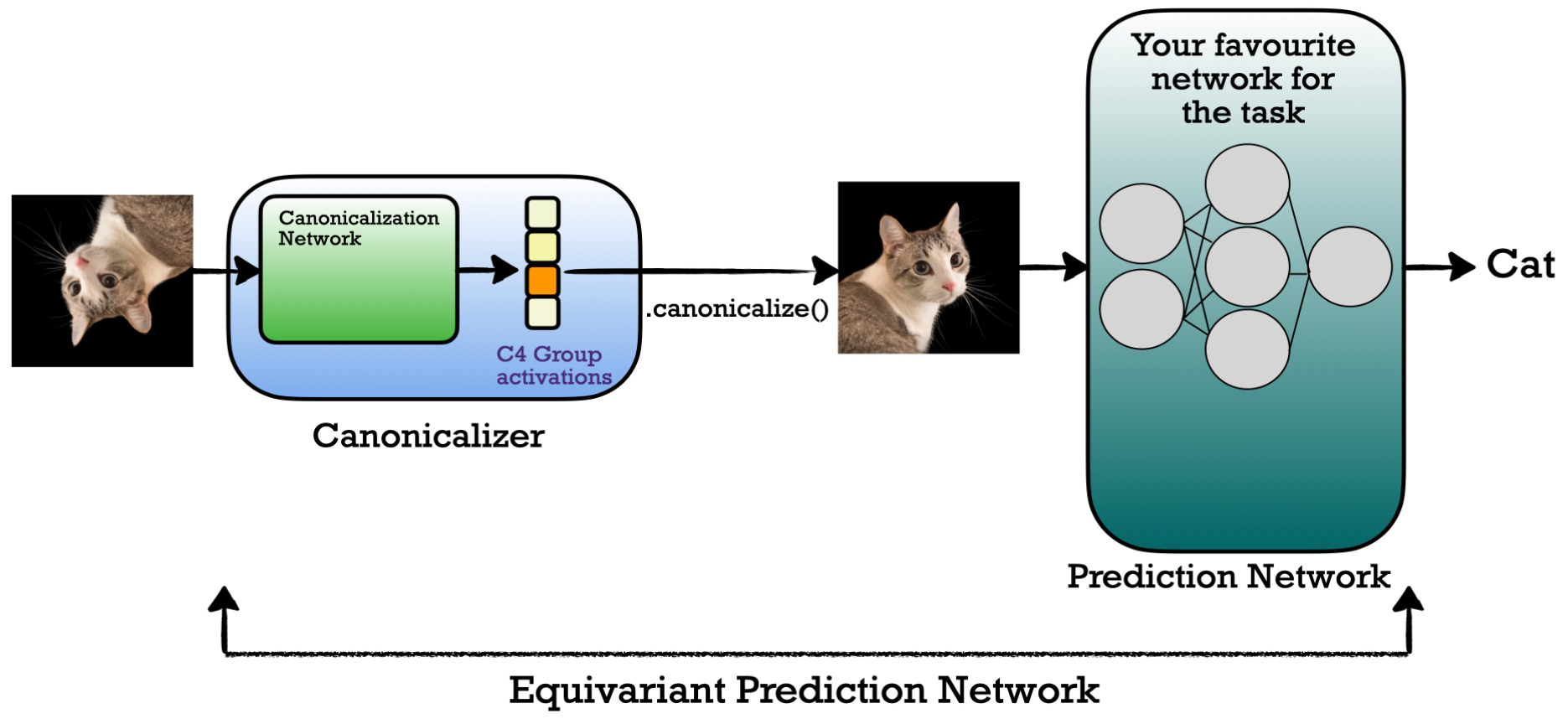
Read more about this here
Prior regularized canonicalization
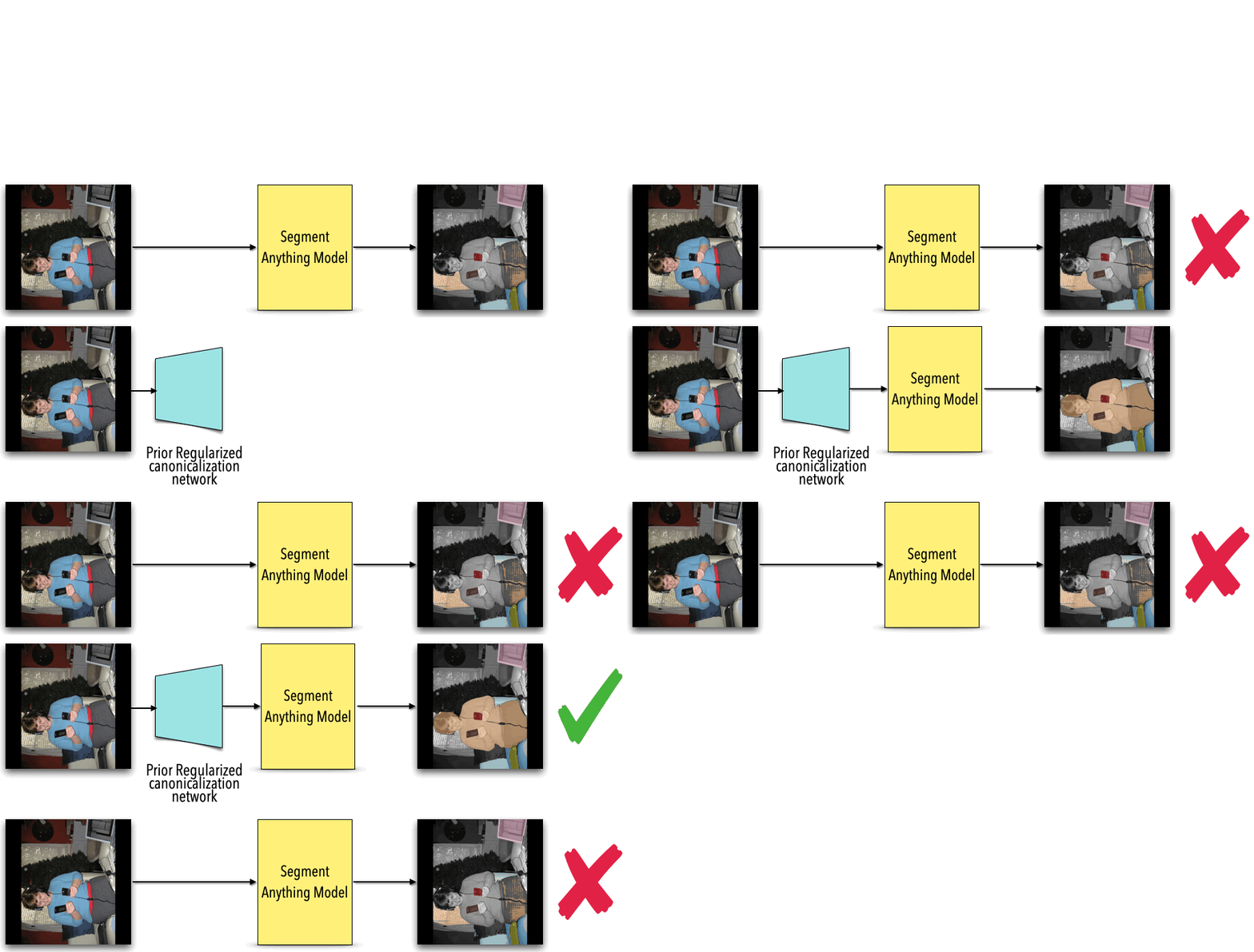
Read more about this here
How to use?
Easy to integrate :rocket:
Equiadapt enables users to obtain equivariant versions of existing neural networks with a few lines of code changes:
  import torch
  import torch.nn.functional as F

+ from equiadapt.images.canonicalization.discrete_group import GroupEquivariantImageCanonicalization
+ from equiadapt.images.canonicalization_networks import ESCNNEquivariantNetwork

  device = torch.device("cuda" if torch.cuda.is_available() else "cpu")

+ canonicalization_network = ESCNNEquivariantNetwork(...) ### create a canonicalization network
+ canonicalizer = GroupEquivariantImageCanonicalization(canonicalization_network, ...) ### wrap it using equiadapt's canonicalization wrapper

  model = torch.hub.load('pytorch/vision:v0.10.0', 'resnet50', pretrained=True).to(device)
  optimizer = torch.optim.Adam(model.parameters())

  train_dataset = datasets.CIFAR10(root="dataset_path", train=True, download=False)
  train_loader = torch.utils.data.DataLoader(train_dataset, batch_size=512, shuffle=True)

  model.train()
  for epoch in range(100):
      for inputs, targets in data:
          inputs = inputs.to(device)
          targets = targets.to(device)

          optimizer.zero_grad()

+         inputs_canonicalized = canonicalizer(inputs) ### canonicalize the inputs
          outputs = prediction_network(inputs_canonicalized) ### pass the canonicalized input data
+         outputs = canonicalizer.invert_canonicalization(outputs) ### optional (if you to invert the outputs for your equivariant task)

          loss = F.cross_entropy(outputs, targets)
+         loss += canonicalizer.get_prior_regularization_loss() ### prior regularization is recommended for pretrained networks

          loss.backward()

          optimizer.step()
Details on using equiadapt library
- Create a
canonicalization network(or use our provided networks: for images, inequiadapt/images/canonicalization_networks/).
canonicalization_network = ESCNNEquivariantNetwork(...)
- Wrap it using
equiadaptwrappers to form acanonicalizer.
To create your custom canonicalizer, you must inherit BaseCanonicalization and define canonicalize() and, optionally, invert_canonicalization(). Please refer to this for custom image canonicalizers.
canonicalizer = GroupEquivariantImageCanonicalization(canonicalization_network, ...)
- Use this wrapper with your code to canonicalize the input data.
inputs_canonicalized = canonicalizer(inputs)
- Define your prediction network and pass the canonicalized input data
prediction_network = torch.hub.load('pytorch/vision:v0.10.0', 'resnet50', pretrained=True)
outputs = prediction_network(inputs_canonicalized)
- Optionally, if required, you can "invert" the canonicalization for equivariant tasks
outputs = canonicalizer.invert_canonicalization(outputs)
- The entire setup is end-to-end trainable. Additionally, you can use
.add_prior_regularizer(loss)to use prior regularization, which is helpful for equivariant adaptation of large pretrained models (Mondal et. al, 2023)
loss = CrossEntropyLoss(outputs, y)
loss = canonicalizer.add_prior_regularizer(loss)
loss.backward()
Installation
Using pypi
You can install the latest release using:
pip install equiadapt
Manual installation
You can clone this repository and manually install it with:
pip install git+https://github.com/arnab39/equiadapt
Setup Conda environment for examples
The recommended way is to manually create an environment and install the dependencies from the min_conda_env.yaml file.
To create a conda environment with the necessary packages:
conda env create -f conda_env.yaml
conda activate equiadapt
pip install -e .
We've noticed that the above command to install the dependencies from conda_env.yml may take very long. A faster way to install the required packages is (should take 5-10 mins):
conda env create -f min_conda_env.yaml
Note that this might not be a complete list of dependencies. If you encounter any issues while running examples, please add the required dependencies from conda_env.yaml and create a pull request.
Running equiadapt using example code
We provide examples to run equiadapt in different data domains and tasks to achieve equivariance.
- Image:
- Point Cloud:
- Nbody Dynamics: Link
Our examples use hydra to configure hyperparameters. Follow the hydra setup instructions to create a .env file with the paths to store all the data, wandb logs and checkpoints.
Create a .env file in the root of the project with the following content:
  export HYDRA_JOBS="/path/to/your/hydra/jobs/directory"
  export WANDB_DIR="/path/to/your/wandb/jobs/directory"
  export WANDB_CACHE_DIR="/path/to/your/wandb/cache/directory"
  export DATA_PATH="/path/to/your/data/directory"
  export CHECKPOINT_PATH="/path/to/your/checkpoint/directory"
You can also find tutorials on how to use equiadapt with minimalistic changes to your own code.
Related papers and Citations
For more insights on this library refer to our original paper on the idea: Equivariance with Learned Canonicalization Function (ICML 2023) and how to extend it to make any existing large pre-trained model equivariant: Equivariant Adaptation of Large Pretrained Models (NeurIPS 2023). An improved approach for designing canonicalization network, which allows non-equivariant and expressive models as equivariant networks is presented in Improved Canonicalization for Model Agnostic Equivariance (CVPR 2024: EquiVision Workshop).
If you find this library or the associated papers useful, please cite the following papers:
@inproceedings{kaba2023equivariance,
  title={Equivariance with learned canonicalization functions},
  author={Kaba, S{\'e}kou-Oumar and Mondal, Arnab Kumar and Zhang, Yan and Bengio, Yoshua and Ravanbakhsh, Siamak},
  booktitle={International Conference on Machine Learning},
  pages={15546--15566},
  year={2023},
  organization={PMLR}
}
@inproceedings{mondal2023equivariant,
  author = {Mondal, Arnab Kumar and Panigrahi, Siba Smarak and Kaba, Oumar and Mudumba, Sai Rajeswar and Ravanbakhsh, Siamak},
  booktitle = {Advances in Neural Information Processing Systems},
  editor = {A. Oh and T. Neumann and A. Globerson and K. Saenko and M. Hardt and S. Levine},
  pages = {50293--50309},
  publisher = {Curran Associates, Inc.},
  title = {Equivariant Adaptation of Large Pretrained Models},
  url = {https://proceedings.neurips.cc/paper_files/paper/2023/file/9d5856318032ef3630cb580f4e24f823-Paper-Conference.pdf},
  volume = {36},
  year = {2023}
}
@inproceedings{
  panigrahi2024im
Related Skills
groundhog
398Groundhog's primary purpose is to teach people how Cursor and all these other coding agents work under the hood. If you understand how these coding assistants work from first principles, then you can drive these tools harder (or perhaps make your own!).
isf-agent
a repo for an agent that helps researchers apply for isf funding
workshop-rules
Materials used to teach the summer camp <Data Science for Kids>
last30days-skill
13.4kAI agent skill that researches any topic across Reddit, X, YouTube, HN, Polymarket, and the web - then synthesizes a grounded summary
