
Webhook Debugger Logger
Enterprise-grade webhook testing suite for developers. Capture, inspect, replay, forward, validate, and mock webhook traffic in real time without tunnels. Includes SSE live streaming, JSON Schema validation, and signature verification for Stripe, GitHub, Shopify, Slack, and custom HMAC workflows.
Install / Use
npx skills add ar27111994/webhook-debugger-loggerInstalls into whichever agent you are using.
README
Webhook Debugger, Logger & API Mocking Suite

Generate temporary webhook URLs, inspect every incoming request, replay failures, and simulate callback behavior without tunneling localhost.
Status








Run & Docs




Sponsor





Contribute






Webhook Debugger, Logger & API Mocking Suite is an Apify Actor for testing webhook integrations end to end. It generates temporary endpoints, captures the full request envelope, exposes live and queryable logs, and lets you replay or forward captured traffic to another destination.
It is designed for developers working with providers such as Stripe, GitHub, Shopify, Slack, and custom internal webhooks who need more than a generic request bin.
[!NOTE] This actor is optimized for testing, debugging, replay, and callback simulation. If you need permanent public ingress or long-term retention, place it behind your own infrastructure or run the self-hosted container with persistent storage.
[!WARNING] Generated webhook URLs are public unless you enable
authKey,allowedIps, or signature verification. Do not point sensitive production traffic to unsecured endpoints.
Screenshots
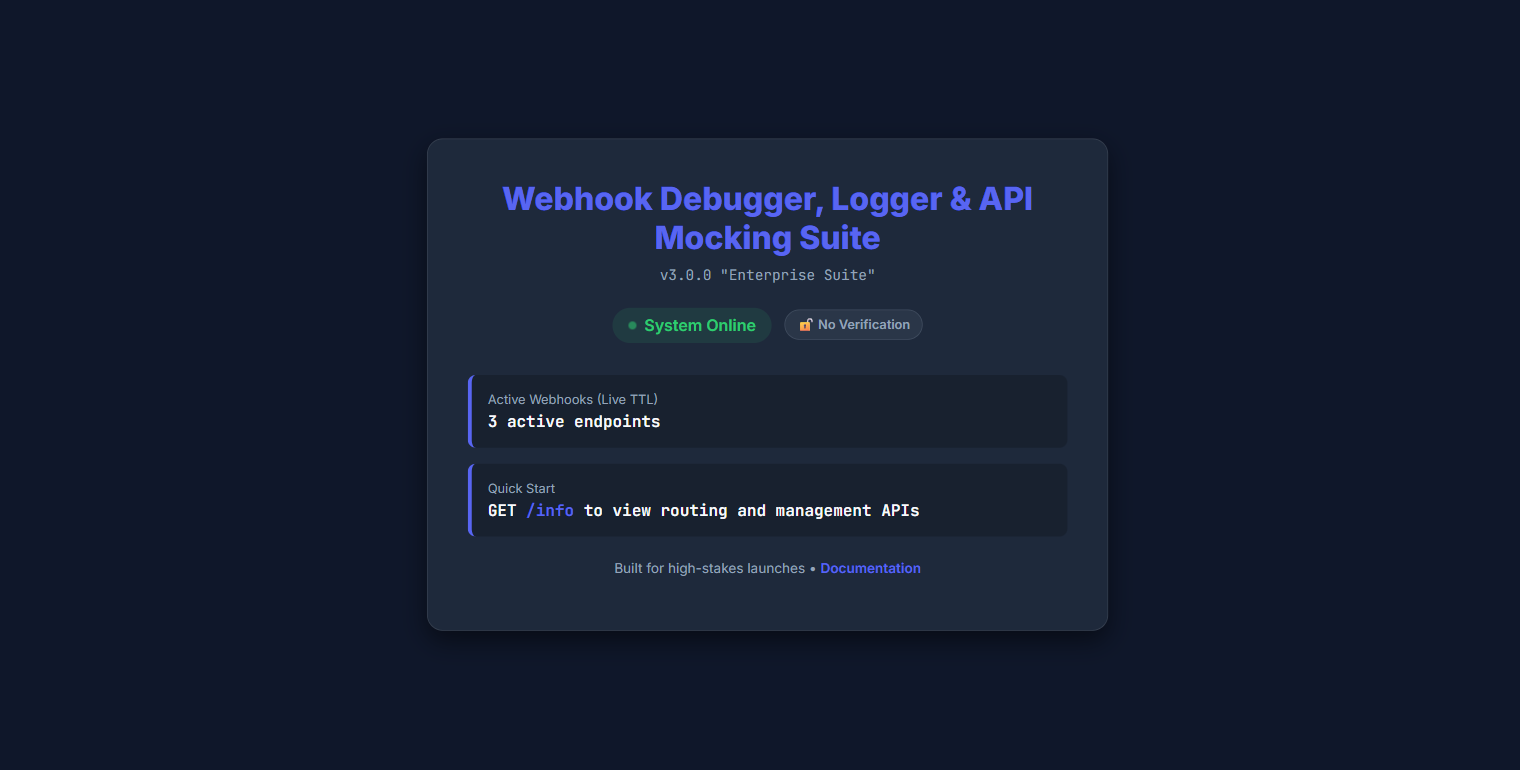
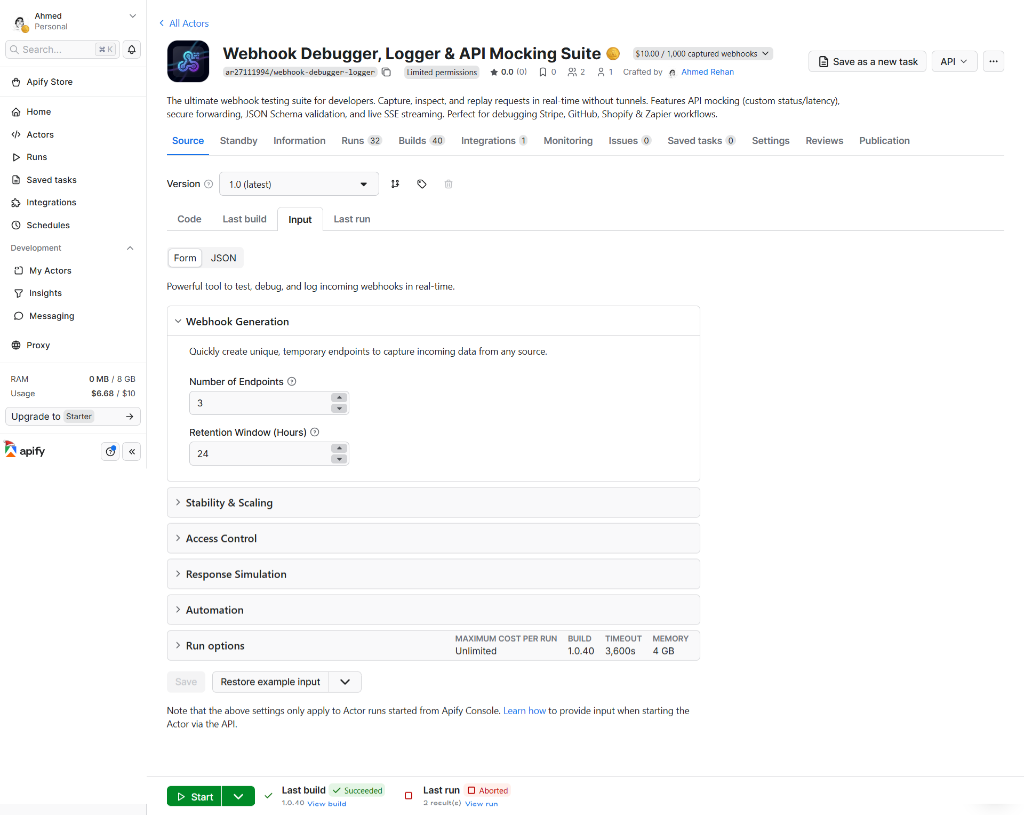
[!NOTE] The Apify Store input tab always reflects the most recently published build. To avoid showing stale configuration fields, this README documents input options from the current repo schema in .actor/input_schema.json and uses a live local runtime screenshot below.
Built-in dashboard
Key input options
The current repo schema is defined in .actor/input_schema.json. These are the settings most users touch first.
| Input | Purpose | Default |
| ----------------------- | ------------------------------------------------------------------------------------------------------------------------ | ---------- |
| urlCount | Number of temporary webhook endpoints to generate | 3 |
| retentionHours | How long generated webhook URLs remain active | 24 |
| maxPayloadSize | Maximum accepted request body size in bytes; values above 100 MB are clamped | 10485760 |
| enableJSONParsing | Parse JSON payloads into structured objects for search | true |
| maskSensitiveData | Redact sensitive headers such as Authorization, Cookie, Set-Cookie, and API key headers from logs | true |
| authKey | Protect management routes and optionally webhook ingest with a shared key | unset |
| allowedIps | Restrict traffic to specific IPs or CIDR blocks | empty |
| signatureVerification | Verify Stripe, Shopify, GitHub, Slack, or custom signatures | unset |
| forwardUrl | Forward every captured request to another destination | unset |
| defaultResponseCode | Return a custom HTTP status to the sender | 200 |
| responseDelayMs | Add an artificial response delay after processing completes; accepted range is 0-10,000 ms and higher values are clamped | 0 |
| jsonSchema | Reject payloads that do not match a JSON Schema | unset |
| customScript | Transform or enrich the captured event before storage | unset |
What does this actor do?
This project gives you a disposable webhook test environment with a documented HTTP API.
It helps you:
- generate 1 to 50 unique webhook URLs for a run
- inspect headers, query params, payloads, response status, timing, IP, and signature state
- stream events live over Server-Sent Events (SSE)
- replay captured requests to a new destination
- forward incoming traffic to another endpoint with retries and circuit breaking
- simulate downstream behavior with custom status codes, response bodies, headers, and latency
- trigger Slack or Discord alerts when a webhook run needs attention
- handle large request bodies by enforcing size limits and offloading oversized accepted payloads to storage
- validate JSON payloads and run custom JavaScript transformation scripts before storage
- plug the actor into Apify-native workflows, API automation, and MCP-enabled tooling that orchest
Related Skills
node-connect
385.5kDiagnose OpenClaw Android, iOS, or macOS node pairing, QR/setup code, route, auth, and connection failures.
prose
385.5kOpenProse VM skill pack. Activate on any `prose` command, .prose files, or OpenProse mentions; orchestrates multi-agent workflows.
blender-python-addon
40.5kBlender Python add-on rules for operators, panels, properties, registration, testing, and API-safe scripting
flutter-development-guidelines-cursorrules-prompt-file
40.5kCursor rules for Flutter development with MVVM architecture, Riverpod state management, Material widgets, and Dart style guidelines.
