
Mxnet
Lightweight, Portable, Flexible Distributed/Mobile Deep Learning with Dynamic, Mutation-aware Dataflow Dep Scheduler; for Python, R, Julia, Scala, Go, Javascript and more
Install / Use
/learn @apache/MxnetREADME
Apache MXNet for Deep Learning









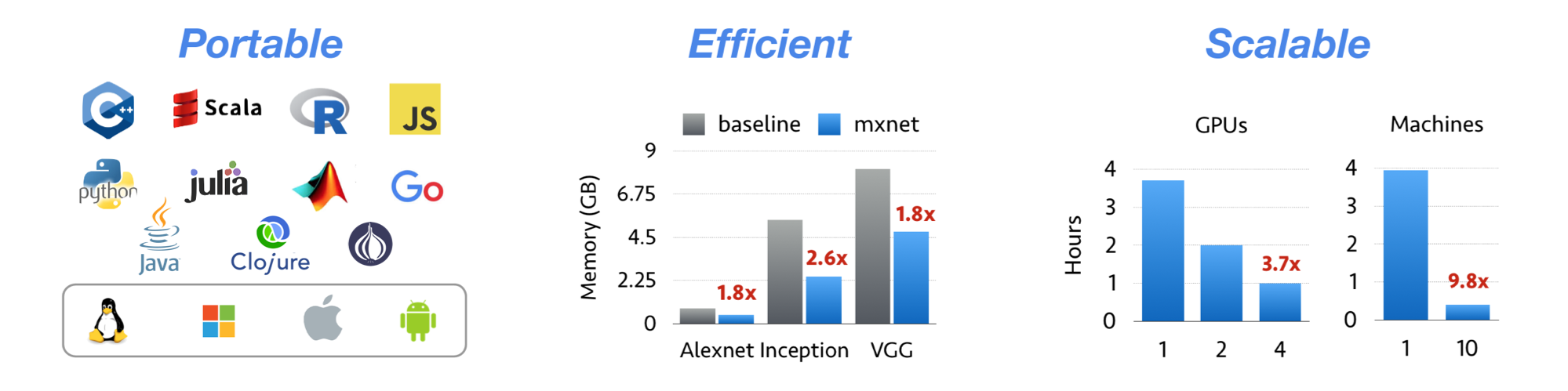
Apache MXNet is a deep learning framework designed for both efficiency and flexibility. It allows you to mix symbolic and imperative programming to maximize efficiency and productivity. At its core, MXNet contains a dynamic dependency scheduler that automatically parallelizes both symbolic and imperative operations on the fly. A graph optimization layer on top of that makes symbolic execution fast and memory efficient. MXNet is portable and lightweight, scalable to many GPUs and machines.
Apache MXNet is more than a deep learning project. It is a community on a mission of democratizing AI. It is a collection of blue prints and guidelines for building deep learning systems, and interesting insights of DL systems for hackers.
Licensed under an Apache-2.0 license.
| Branch | Build Status |
|:-------:|:-------------:|
| master |
<br>
<br>
<br>
|
| v1.x |
<br>
<br>
<br>
|
Features
- NumPy-like programming interface, and is integrated with the new, easy-to-use Gluon 2.0 interface. NumPy users can easily adopt MXNet and start in deep learning.
- Automatic hybridization provides imperative programming with the performance of traditional symbolic programming.
- Lightweight, memory-efficient, and portable to smart devices through native cross-compilation support on ARM, and through ecosystem projects such as TVM, TensorRT, OpenVINO.
- Scales up to multi GPUs and distributed setting with auto parallelism through ps-lite, Horovod, and BytePS.
- Extensible backend that supports full customization, allowing integration with custom accelerator libraries and in-house hardware without the need to maintain a fork.
- Support for Python, Java, C++, R, Scala, [Clojure](ht
