
ElispCheatSheet
Quick reference to the core language of Emacs ---Editor MACroS.
Install / Use
/learn @alhassy/ElispCheatSheetREADME
Quick reference to the core language of Emacs —Editor MACroS.
◈ Website ◈
( It's mostly Common Lisp in Elisp syntax, for now; based on reading Land of Lisp. )
The listing sheet, as PDF, can be found here, while below is an unruly html rendition.
This reference sheet is built around an Org-mode CheatSheet system.
Table of Contents
- Functions
- Quotes, Quasi-Quotes, and Unquotes
- Reads
- Variables
- Lists and List-Like Structures
- Generic Setters
- Records
- Block of Code
- Conditionals
- Loops
- Exception Handling
- Types & Overloading
- Macros
readandprint
Everything is a list!
- To find out more about
nameexecute(describe-symbol 'name)!- After the closing parens invoke
C-x C-eto evaluate.
- After the closing parens invoke
- To find out more about a key press, execute
C-h kthen the key press. - To find out more about the current mode you're in, execute
C-h mordescribe-mode. Essentially a comprehensive yet terse reference is provided.
<a id="orgcae400a"></a>
Functions
-
Function invocation:
(f x₀ x₁ … xₙ). E.g.,(+ 3 4)or(message "hello").-
After the closing parens invoke
C-x C-eto execute them. -
Warning! Arguments are evaluated before the function is executed.
-
Only prefix invocations means we can use
-,+,*in names since(f+*- a b)is parsed as applying functionf+*-to argumentsa, b.E.g.,
(1+ 42) → 43using function named1+—the ‘successor function’.
-
-
Function definition:
;; “de”fine “fun”ctions (defun my-fun (arg₀ arg₁ … argₖ) ;; header, signature "This functions performs task …" ;; documentation, optional …sequence of instructions to perform… ) ;; body- The return value of the function is the result of the last expression executed.
- The documentation string may indicate the return type, among other things.
-
Anonymous functions:
<div class="parallel"> ;; make then way later invoke (setq my-f (lambda (x y) (+ x y))) (funcall my-f 1 2) ;; ⇒ 3 ;; (my-f 1 2) ;; invalid! (funcall my-f 1 2) ;; ⇒ 3(lambda (arg₀ … argₖ) bodyHere).\columnbreak
</div>;; make and immediately invoke (funcall (lambda (x y) (+ x y)) 1 2) ;; works, but is deprecated ((lambda (x y) (+ x y)) 1 2)
Functions are first-class values but variables and functions have separate namespaces
—“Elisp is a Lisp-2 Language”.
The function represented by the name g is obtained
by the call (function g), which is also denoted #'g.
The sharp quote behaves like the usual quote but causes its argument to be compiled.
lambda is a macro that calls function and so there is rarely any need to quote lambdas.
If h is a variable referring to a function, then (funcall h x₀ … xₙ)
calls that function on arguments xᵢ.
;; Recursion with the ‘tri’angle numbers: tri n = Σⁿᵢ₌₀ i.
(defun tri (f n) (if (<= n 0) 0 (+ (funcall f n) (tri f (- n 1)))))
(tri #'identity 100)           ;; ⇒ 5050
(tri (lambda (x) (/ x 2)) 100) ;; ⇒ 2500

;; Run “C-h o tri” to see TWO items! Location determines dispatch.
(setq tri 100) (tri #'identity tri)      ;; ⇒ 5050
(setq tri (lambda (x) x)) (tri tri 100)  ;; ⇒ 5050
- →: Use
funcallorapplyto call functions bound to variables. - →: Refer to functions outside of function calls by using a sharp quote,
#'.
We may have positional optional arguments, or optional but named arguments
—for which position does not matter.
Un-supplied optional arguments are bound to nil.
(f 'a)       ;; ⇒ "a nil 5"
(f 'a 'b)    ;; ⇒ "a b 5"
(f 'a 'b 'c) ;; ⇒ "a b c"

(cl-defun g (a &key (b 'nice) c)
   (format "%s %s %s" a b c))

(g 1 :c 3 :b 2) ;; ⇒ "1 2 3"
(g 1 :c 3)      ;; ⇒ "1 nice 3"
Keywords begin with a colon, :k is a constant whose value is :k.
<a id="orge624d54"></a>
Quotes, Quasi-Quotes, and Unquotes
Quotes: 'x refers to the name rather than the value of x.
- This is superficially similar to pointers:
Given
int *x = …,xis the name (address) whereas*xis the value. - The quote simply forbids evaluation; it means take it literally as you see it rather than looking up the definition and evaluating.
- Note:
'x ≈ (quote x).
Akin to English, quoting a word refers to the word and not what it denotes.
This lets us treat code as data! E.g., '(+ 1 2) evaluates to (+ 1 2), a function call,
not the value 3! Another example, * is code but '*
is data, and so (funcall '* 2 4) yields 8.
Elisp expressions are either atoms or function application –nothing else!
‘Atoms’ are the simplest objects in Elisp: They evaluate to themselves; \newline
e.g., 5, "a", 2.78, 'hello, [1 "two" three].
An English sentence is a list of words; if we want to make a sentence where some of
the words are parameters, then we use a quasi-quote –it's like a quote, but allows
us to evaluate data if we prefix it with a comma. It's usually the case that the
quasi-quoted sentence happens to be a function call! In which case, we use eval
which executes code that is in data form; i.e., is quoted.
Macros are essentially functions that return sentences, lists, which may happen to contain code.
<div class="parallel"> ;; Quotes / sentences / data '(I am a sentence) '(+ 1 (+ 1 1));; Executing data as code
(eval '(+ 1 (+ 1 1))) ;; ⇒ 3
(setq name "Jasim")
;; Quasi-quotes: Sentences with a
;; computation, code, in them.
`(Hello ,name and welcome)
`(+ 1 ,(+ 1 1)) ;; ⇒ '(+ 1 2)
As the final example shows, Lisp treats data and code interchangeably. A language that uses the same structure to store data and code is called ‘homoiconic’.
<a id="orgdb68da1"></a>
Reads
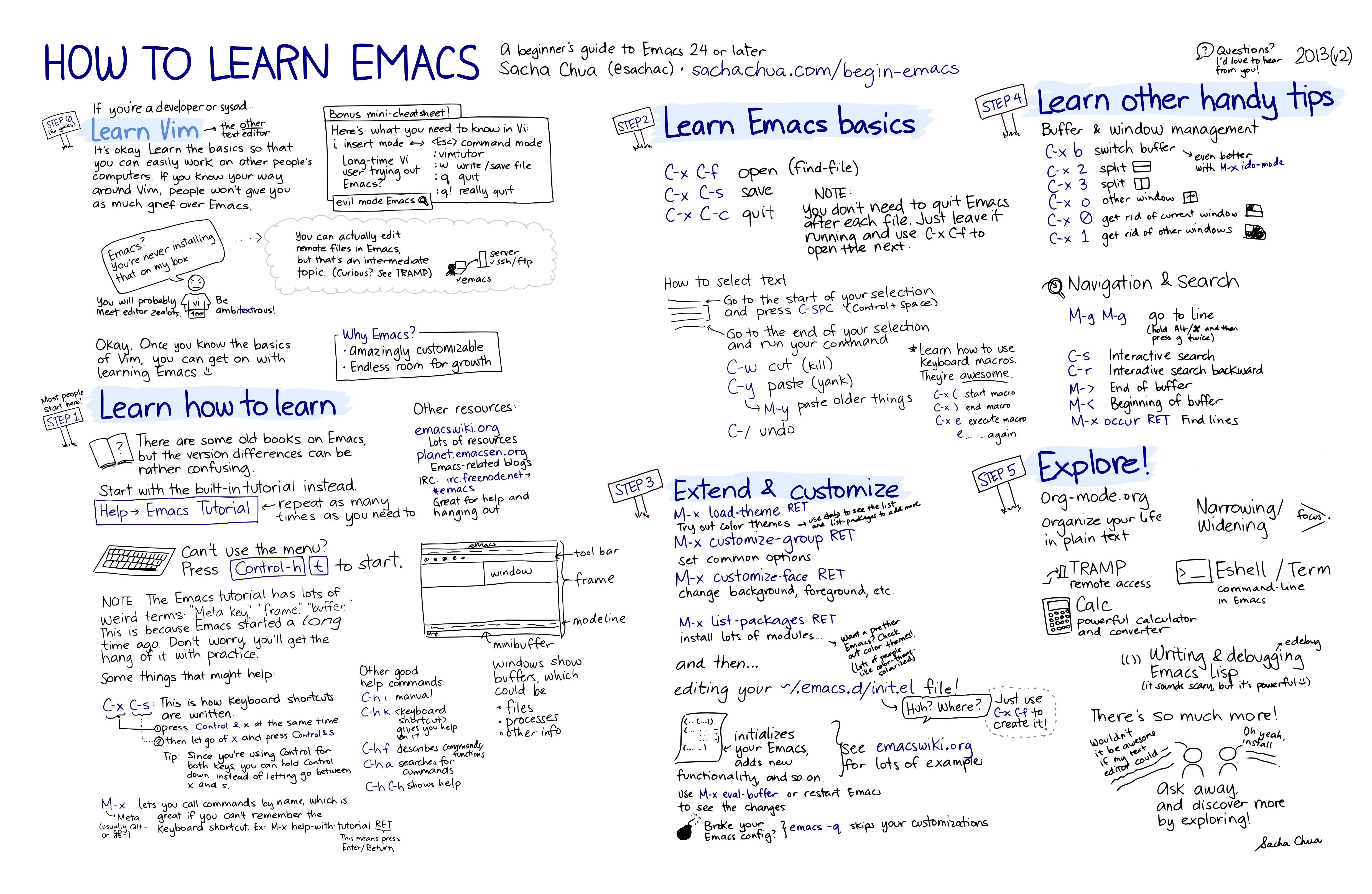
- How to Learn Emacs: A Hand-drawn One-pager for Beginners / A visual tutorial
- Learn Emacs Lisp in 15 minutes — https://learnxinyminutes.com/
- An Introduction to Programming in Emacs Lisp Land of Lisp
- GNU Emacs Lisp Reference Manual
<a id="org943c427"></a>
Variables
-
Global Variables, Create & Update:
(setq name value).- Generally:
(setq name₀ value₀ ⋯ nameₖ valueₖ).
Use
<table border="2" cellspacing="0" cellpadding="6" rules="groups" frame="hsides"> <colgroup> <col class="org-left" /> </colgroup> <tbody> <tr> <td class="org-left">`(setq x y) ≈ (set (quote x) y)`</td> </tr> </tbody> </table>devfarfor global variables since it permits a documentation string –but updates must be performed withsetq. E.g.,(defvar my-x 14 "my cool thing").Variables are assigned with
set, which takes a quoted identifier, so that it's not evaluated, and a value to associate to that variable. “set quoted”,setq, avoids the hassle of quoting the name. More generally,(set sym v)assigns the value ofsymto have the valuev. - Generally:
-
Local Scope:
(let ((name₀ val₀) … (nameₖ valₖ)) bodyBlock).let*permits later bindings to refer to earlier ones.- The simpler
letindicates to the reader that there are no dependencies between the variables. - let ≈ parallel; let* ≈ sequential.
- Local functions declared with
fletandflet*; e.g.,(flet ((go (x) (+ 2 x))) (go 3)).
-
Any sequence of symbols is a valid identifier, including
x, x-y/z, --<<==>>--and even∀∃. Elisp names are case sensitive. -
Elisp is dynamically scoped: The caller's stack is accessible by default!
(defun woah ()
  "If any caller has a local ‘work’, they're in for a nasty bug
   from me! Moreover, they better have ‘a’ defined in scope!"
  (setq work (* a 111))) ;; Benefit: Variable-based scoped configuration.

(defun add-one (x)
  "Just adding one to input, innocently calling library method ‘woah’."
  (let ((work (+ 1 x)) (a 6))
    (woah) ;; May change ‘work’ or access ‘a’!
    work
  )
)

;; (add-one 2) ⇒ 666
<a id="orgbc87d9e"></a>
Lists and List-Like Structures
-
Produce a syntactic, un-evaluated list, we use the single quote:
'(1 2 3). -
Construction:
(cons 'x₀ '(x₁ … xₖ)) → (x₀ x₁ … xₖ). -
Head, or contents of the address part of the register:
(car '(x₀ x₁ … xₖ)) → x₀. -
Tail, or contents of the decrement part of the register:
(cdr '(x₀ x₁ … xₖ)) → (x₁ … xₖ).
E.g., (cons 1 (cons "a" (cons 'nice nil))) ≈ (list 1 "a" 'nice) ≈ '(1 "a" nice).
Since variables refer to literals and functions have lambdas as literals, we
can produce forms that take functions as arguments. E.g., the standard mapcar
m
Related Skills
node-connect
350.8kDiagnose OpenClaw node connection and pairing failures for Android, iOS, and macOS companion apps
frontend-design
110.4kCreate distinctive, production-grade frontend interfaces with high design quality. Use this skill when the user asks to build web components, pages, or applications. Generates creative, polished code that avoids generic AI aesthetics.
summarize
350.8kSummarize or extract text/transcripts from URLs, podcasts, and local files (great fallback for “transcribe this YouTube/video”).
feishu-doc
350.8k|

Security Score
Audited on Mar 13, 2026