
Bufferline.nvim
A snazzy bufferline for Neovim
Install / Use
/learn @akinsho/Bufferline.nvimREADME

- Requirements
- Installation
- Usage
- Configuration
- Features
- How do I see only buffers per tab?
- Caveats
- FAQ
This plugin shamelessly attempts to emulate the aesthetics of GUI text editors/Doom Emacs. It was inspired by a screenshot of DOOM Emacs using centaur tabs.
Requirements
- Neovim 0.8+
- A patched font (see nerd fonts)
- A colorscheme (either your custom highlight or a maintained one somewhere)
Installation
It is advised that you specify either the latest tag or a specific tag and bump them manually if you'd prefer to inspect changes before updating.
If you'd like to use an older version of the plugin compatible with nvim-0.6.1 and below please change your tag to tag = "v1.*"
Lua
-- using packer.nvim
use {'akinsho/bufferline.nvim', tag = "*", requires = 'nvim-tree/nvim-web-devicons'}

-- using lazy.nvim
{'akinsho/bufferline.nvim', version = "*", dependencies = 'nvim-tree/nvim-web-devicons'}
Vimscript
Plug 'nvim-tree/nvim-web-devicons' " Recommended (for coloured icons)
" Plug 'ryanoasis/vim-devicons' Icons without colours
Plug 'akinsho/bufferline.nvim', { 'tag': '*' }
Usage
See the docs for details :h bufferline.nvim
You need to be using termguicolors for this plugin to work, as it reads the hex gui color values
of various highlight groups.
Vimscript
" In your init.lua or init.vim
set termguicolors
lua << EOF
require("bufferline").setup{}
EOF
Lua
vim.opt.termguicolors = true
require("bufferline").setup{}
You can close buffers by clicking the close icon or by right clicking the tab anywhere
Configuration
for more details on how to configure this plugin in details please see :h bufferline-configuration
Features
-
Colours derived from colorscheme where possible.
-
Sort buffers by
extension,directoryor pass in a custom compare function -
Configuration via lua functions for greater customization.
Alternate styling
Slanted tabs

NOTE: some terminals require special characters to be padded so set the style to padded_slant if the appearance isn't right in your terminal emulator. Please keep in mind
though that results may vary depending on your terminal emulator of choice and this style might not work for all terminals
Sloped tabs

see: :h bufferline-styling
Hover events
NOTE: this is only available for >= neovim 0.8+

see :help bufferline-hover-events for more information on configuration
Underline indicator
<img width="1355" alt="Screen Shot 2022-08-22 at 09 14 24" src="https://user-images.githubusercontent.com/22454918/185873089-2ae20db0-f292-4d96-afe4-ef0683a60709.png">NOTE: as with the above your mileage will vary based on your terminal emulator. The screenshot above was achieved using kitty nightly (as of August 2022), with increased underline thickness and an increased underline position so it sits further from the text
Tabpages
<img width="800" alt="Screen Shot 2022-03-08 at 17 39 57" src="https://user-images.githubusercontent.com/22454918/157337891-1848da24-69d6-4970-96ee-cf65b2a25c46.png">This plugin can also be set to show only tabpages. This can be done by setting the mode option to tabs. This will change the bufferline to a tabline
it has a lot of the same features/styling but not all.
A few things to note are
- Sorting doesn't work yet as that needs to be thought through.
- Grouping doesn't work yet as that also needs to be thought through.
LSP indicators

By setting diagnostics = "nvim_lsp" | "coc" you will get an indicator in the bufferline for a given tab if it has any errors
This will allow you to tell at a glance if a particular buffer has errors.
In order to customise the appearance of the diagnostic count you can pass a custom function in your setup.
<details> <summary><b>snippet</b></summary>-- rest of config ...
--- count is an integer representing total count of errors
--- level is a string "error" | "warning"
--- diagnostics_dict is a dictionary from error level ("error", "warning" or "info")to number of errors for each level.
--- this should return a string
--- Don't get too fancy as this function will be executed a lot
diagnostics_indicator = function(count, level, diagnostics_dict, context)
local icon = level:match("error") and " " or " "
return " " .. icon .. count
end

diagnostics_indicator = function(count, level, diagnostics_dict, context)
local s = " "
for e, n in pairs(diagnostics_dict) do
local sym = e == "error" and " "
or (e == "warning" and " " or " ")
s = s .. n .. sym
end
return s
end
The highlighting for the file name if there is an error can be changed by replacing the highlights for see:
:h bufferline-highlights
LSP indicators can additionally be reported conditionally, based on buffer context. For instance, you could disable reporting LSP indicators for the current buffer and only have them appear for other buffers.
diagnostics_indicator = function(count, level, diagnostics_dict, context)
if context.buffer:current() then
return ''
end
return ''
end


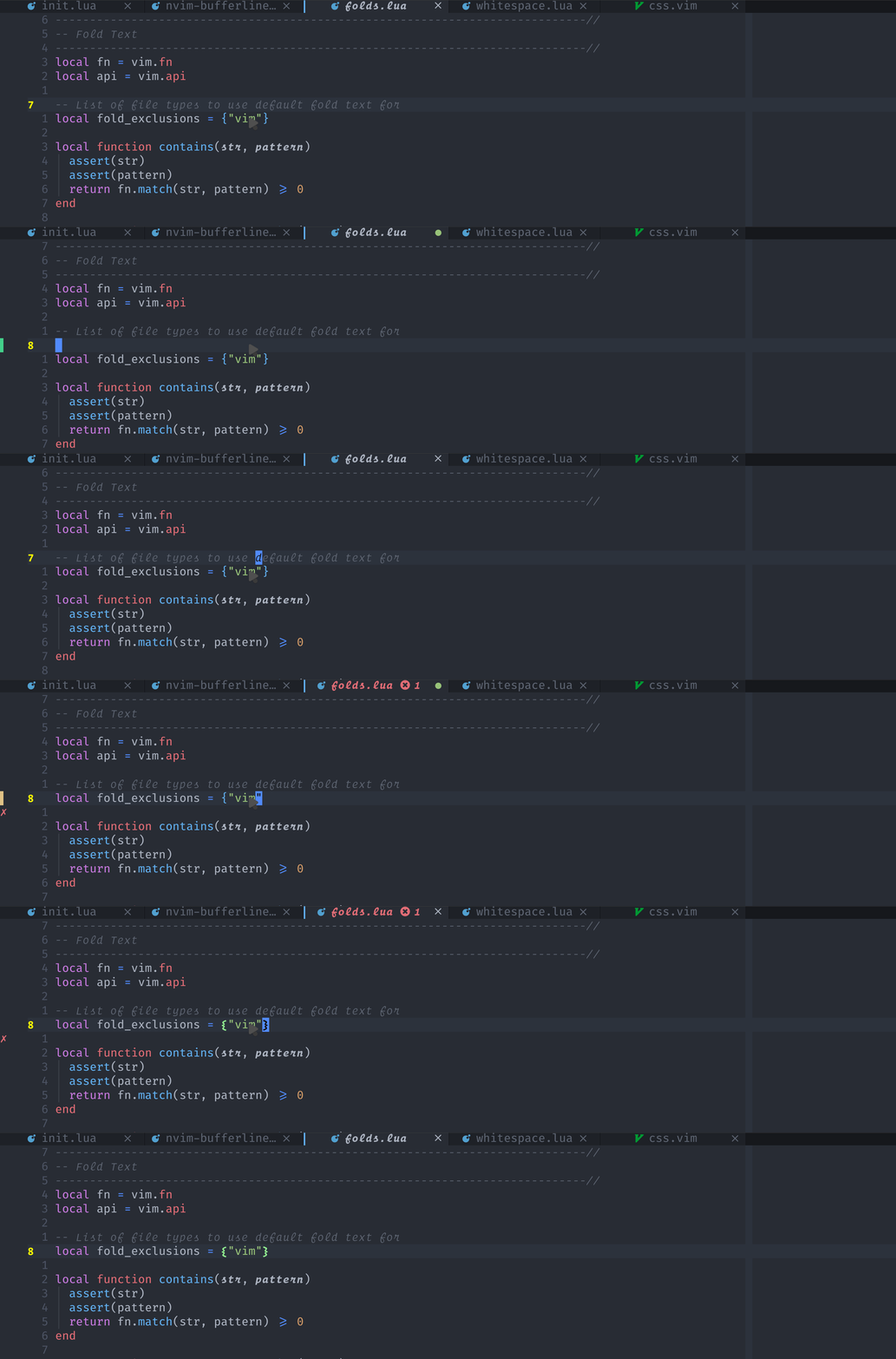
The first bufferline shows diagnostic.lua as the currently opened current buffer. It has LSP reported errors, but they don't show up in the bufferline.
The second bufferline shows 500-nvim-bufferline.lua as the currently opened current buffer. Because the 'faulty' diagnostic.lua buffer has now transitioned from current to visible, the LSP indicator does show up.
Groups

The buffers this plugin shows can be grouped based on a users configuration. Groups are a way of allowing a user to visualize related buffers in clusters as well as operating on them together e.g. by clicking the group indicator all grouped buffers can be hidden. They are partially inspired by google chrome's tabs as well as centaur tab's groups.
see :help bufferline-groups for more information on how to set these up
Sidebar offsets

Numbers

You can prefix buffer names with either the ordinal or buffer id, using the numbers option.
Currently this can be specified as either a string of buffer_id | ordinal or a function

see :help bufferline-numbers for more details
Unique names

Close icons

Re-ordering

This order can be persisted between sessions (enabled by default).
Picking

Pinning
<img width="899" alt="Screen Shot 2022-03-31 at 18 13 50" src="https://user-images.githubusercontent.com/22454918/161112867-ba48fdf6-42ee-4cd3-9e1a-7118c4a2738b.png">Custom areas

see :help bufferline-custom-areas
How do I see only buffers per tab?
This behaviour is not native in neovim there is no internal concept of localis
