
KerasGA
Training Keras Models by the Genetic Algorithm using PyGAD
Install / Use
/learn @ahmedfgad/KerasGAREADME
KerasGA: Training Keras Models using the Genetic Algorithm
KerasGA is part of the PyGAD library for training Keras models using the genetic algorithm (GA).
The KerasGA project has a single module named kerasga.py which has a class named KerasGA for preparing an initial population of Keras model parameters.
PyGAD is an open-source Python library for building the genetic algorithm and training machine learning algorithms. Check the library's documentation at Read The Docs: https://pygad.readthedocs.io
Donation
- Credit/Debit Card: https://donate.stripe.com/eVa5kO866elKgM0144
- Open Collective: opencollective.com/pygad
- PayPal: Use either this link: paypal.me/ahmedfgad or the e-mail address ahmed.f.gad@gmail.com
- Interac e-Transfer: Use e-mail address ahmed.f.gad@gmail.com
Installation
To install PyGAD, simply use pip to download and install the library from PyPI (Python Package Index). The library lives a PyPI at this page https://pypi.org/project/pygad.
pip3 install pygad
To get started with PyGAD, please read the documentation at Read The Docs https://pygad.readthedocs.io.
PyGAD Source Code
The source code of the PyGAD modules is found in the following GitHub projects:
- pygad: (https://github.com/ahmedfgad/GeneticAlgorithmPython)
- pygad.nn: https://github.com/ahmedfgad/NumPyANN
- pygad.gann: https://github.com/ahmedfgad/NeuralGenetic
- pygad.cnn: https://github.com/ahmedfgad/NumPyCNN
- pygad.gacnn: https://github.com/ahmedfgad/CNNGenetic
- pygad.kerasga: https://github.com/ahmedfgad/KerasGA
- pygad.torchga: https://github.com/ahmedfgad/TorchGA
The documentation of PyGAD is available at Read The Docs https://pygad.readthedocs.io.
PyGAD Documentation
The documentation of the PyGAD library is available at Read The Docs at this link: https://pygad.readthedocs.io. It discusses the modules supported by PyGAD, all its classes, methods, attribute, and functions. For each module, a number of examples are given.
If there is an issue using PyGAD, feel free to post at issue in this GitHub repository https://github.com/ahmedfgad/GeneticAlgorithmPython or by sending an e-mail to ahmed.f.gad@gmail.com.
If you built a project that uses PyGAD, then please drop an e-mail to ahmed.f.gad@gmail.com with the following information so that your project is included in the documentation.
- Project title
- Brief description
- Preferably, a link that directs the readers to your project
Please check the Contact Us section for more contact details.
Life Cycle of PyGAD
The next figure lists the different stages in the lifecycle of an instance of the pygad.GA class. Note that PyGAD stops when either all generations are completed or when the function passed to the on_generation parameter returns the string stop.
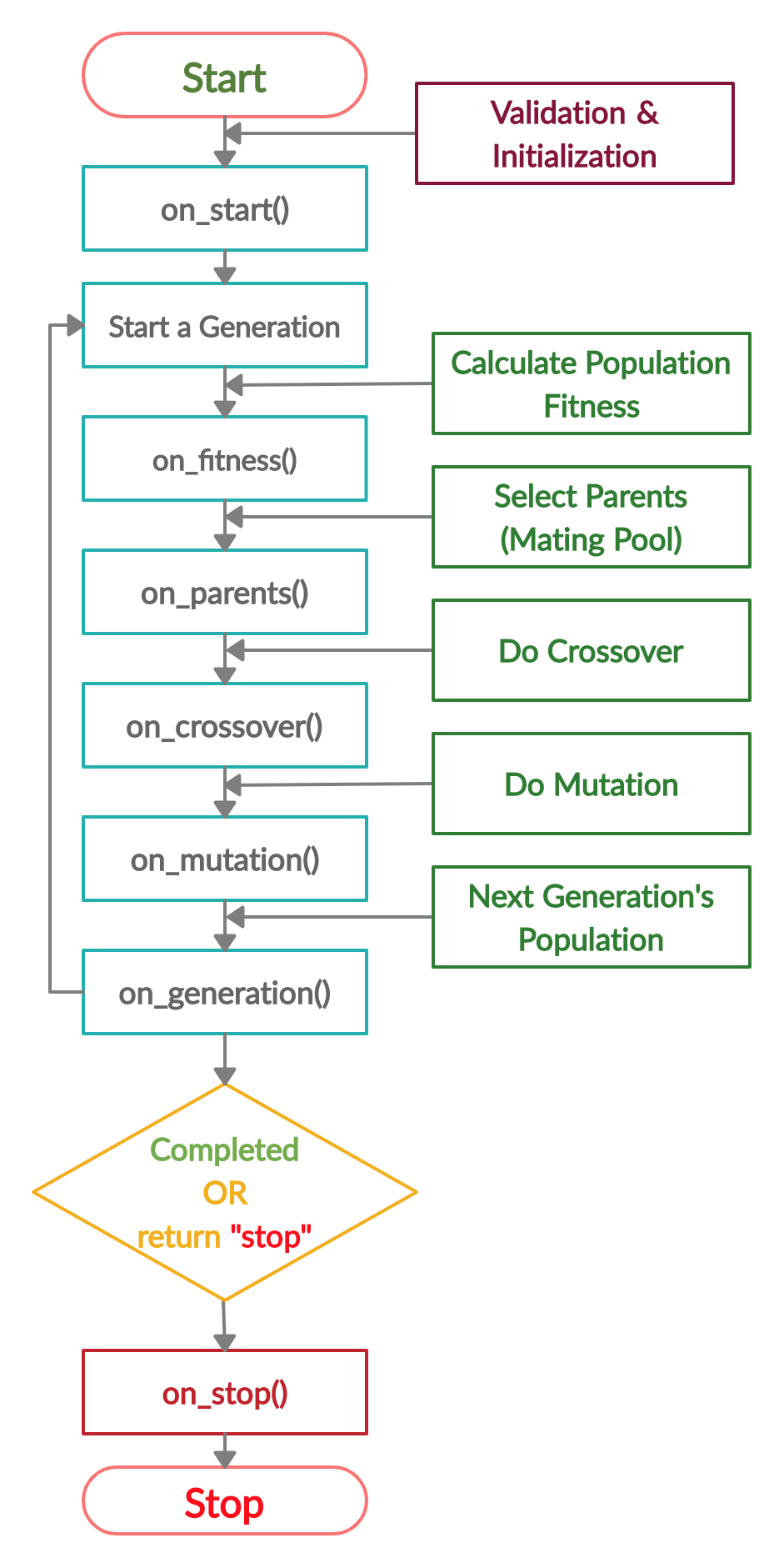
The next code implements all the callback functions to trace the execution of the genetic algorithm. Each callback function prints its name.
import pygad
import numpy

function_inputs = [4,-2,3.5,5,-11,-4.7]
desired_output = 44

def fitness_func(ga_instance, solution, solution_idx):
    output = numpy.sum(solution*function_inputs)
    fitness = 1.0 / (numpy.abs(output - desired_output) + 0.000001)
    return fitness

fitness_function = fitness_func

def on_start(ga_instance):
    print("on_start()")

def on_fitness(ga_instance, population_fitness):
    print("on_fitness()")

def on_parents(ga_instance, selected_parents):
    print("on_parents()")

def on_crossover(ga_instance, offspring_crossover):
    print("on_crossover()")

def on_mutation(ga_instance, offspring_mutation):
    print("on_mutation()")

def on_generation(ga_instance):
    print("on_generation()")

def on_stop(ga_instance, last_population_fitness):
    print("on_stop()")

ga_instance = pygad.GA(num_generations=3,
                       num_parents_mating=5,
                       fitness_func=fitness_function,
                       sol_per_pop=10,
                       num_genes=len(function_inputs),
                       on_start=on_start,
                       on_fitness=on_fitness,
                       on_parents=on_parents,
                       on_crossover=on_crossover,
                       on_mutation=on_mutation,
                       on_generation=on_generation,
                       on_stop=on_stop)

ga_instance.run()
Based on the used 3 generations as assigned to the num_generations argument, here is the output.
on_start()

on_fitness()
on_parents()
on_crossover()
on_mutation()
on_generation()

on_fitness()
on_parents()
on_crossover()
on_mutation()
on_generation()

on_fitness()
on_parents()
on_crossover()
on_mutation()
on_generation()

on_stop()
Examples
Check the PyGAD's documentation for more examples information. You can also find more information about the implementation of the examples.
Example 1: Train Keras Regression Model
import tensorflow.keras
import pygad.kerasga
import numpy
import pygad

def fitness_func(ga_instance, solution, sol_idx):
    global data_inputs, data_outputs, keras_ga, model

    model_weights_matrix = pygad.kerasga.model_weights_as_matrix(model=model,
                                                                 weights_vector=solution)

    model.set_weights(weights=model_weights_matrix)

    predictions = model.predict(data_inputs)
    mae = tensorflow.keras.losses.MeanAbsoluteError()
    abs_error = mae(data_outputs, predictions).numpy() + 0.00000001
    solution_fitness = 1.0/abs_error

    return solution_fitness

def callback_generation(ga_instance):
    print("Generation = {generation}".format(generation=ga_instance.generations_completed))
    print("Fitness    = {fitness}".format(fitness=ga_instance.best_solution()[1]))

input_layer  = tensorflow.keras.layers.Input(3)
dense_layer1 = tensorflow.keras.layers.Dense(5, activation="relu")(input_layer)
output_layer = tensorflow.keras.layers.Dense(1, activation="linear")(dense_layer1)

model = tensorflow.keras.Model(inputs=input_layer, outputs=output_layer)

keras_ga = pygad.kerasga.KerasGA(model=model,
                                 num_solutions=10)

# Data inputs
data_inputs = numpy.array([[0.02, 0.1, 0.15],
                           [0.7, 0.6, 0.8],
                           [1.5, 1.2, 1.7],
                           [3.2, 2.9, 3.1]])

# Data outputs
data_outputs = numpy.array([[0.1],
                            [0.6],
                            [1.3],
                            [2.5]])

# Prepare the PyGAD parameters. Check the documentation for more information: https://pygad.readthedocs.io/en/latest/pygad.html#pygad-ga-class
num_generations = 250 # Number of generations.
num_parents_mating = 5 # Number of solutions to be selected as parents in the mating pool.
initial_population = keras_ga.population_weights # Initial population of network weights

ga_instance = pygad.GA(num_generations=num_generations,
                       num_parents_mating=num_parents_mating,
                       initial_population=initial_population,
                       fitness_func=fitness_func,
                       on_generation=callback_generation)

ga_instance.run()

# After the generations complete, some plots are showed that summarize how the outputs/fitness values evolve over generations.
ga_instance.plot_fitness(title="PyGAD & Keras - Iteration vs. Fitness", linewidth=4)

# Returning the details of the best solution.
solution, solution_fitness, solution_idx = ga_instance.best_solution()
print("Fitness value of the best solution = {solution_fitness}".format(solution_fitness=solution_fitness))
print("Index of the best solution : {solution_idx}".format(solution_idx=solution_idx))

# Fetch the parameters of the best solution.
best_solution_weights = pygad.kerasga.model_weights_as_matrix(model=model,
                                                              weights_vector=solution)
model.set_weights(best_solution_weights)
predictions = model.predict(data_inputs)
print("Predictions : \n", predictions)

mae = tensorflow.keras.losses.MeanAbsoluteError()
abs_error = mae(data_outputs, predictions).numpy()
print("Absolute Error : ", abs_error)
Example 2: XOR Binary Classification
import tensorflow.keras
import pygad.kerasga
import numpy
import pygad

def fitness_func(ga_instance, solution, sol_idx):
    global data_inputs, data_outputs, keras_ga, model

    model_weights_matrix = pygad.kerasga.model_weights_as_matrix(model=model,
                                                                 weights_vector=solution)

    model.set_weights(weights=model_weights_matrix)

    predictions = model.predict(data_inputs)

    bce = tensorflow.keras.losses.BinaryCrossentropy()
    solution_fitness = 1.0 / (bce(data_outputs, predictions).numpy() + 0.00000001)

    return solution_fitness

def callback_generation(ga_instance):
    print("Generation = {generation}".format(generation=ga_instance.generations_completed)
