
Intertwingled
A collection of videos to showcase the magic alchemy of computation.
Install / Use
/learn @ahdinosaur/IntertwingledREADME
EVERYTHING IS DEEPLY INTERTWINGLED

A collection of videos to showcase the magic alchemy of computation. ✨
What is computing if you take away all hardware in front of your eyes? 🌱
What does computing mean to humanity? 🌻
- PeerTube: @intertwingled@tube.arthack.nz
- GitHub: ahdinosaur/intertwingled
Not sure where to start?
- (2013) The Future of Programming : Bret Victor
- (1997) The Computer Revolution Hasn't Happened Yet : Alan Kay
See also:
To add or remove a video, see contributing guide.
(2019) Lets LISP like its 1959 : Kristoffer Gronlund
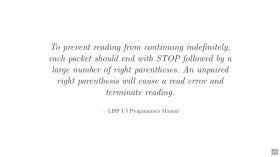
One of my favorite papers in computer science is the original LISP paper by John McCarthy. Written in 1959, it describes something mind-bending: The interpreter for a language in the language that it interprets. If you understand this paper, you understand how computation works.
Source: https://archive.org/details/lca2019-Lets_LISP_like_its_1959
(2018) Whole Earth Flashbacks
A 40-minute video compilation of filmclips, photos and videos from the 50 year history of the Whole Earth publications (plus sponsored/hosted events and contributors) created for the 50th anniversary event at the San Francisco Art Institute on 13 October 2018.
Source: https://vimeo.com/294878432/3ff748dd5e
(2017) Yesterday's Computer of Tomorrow: The Xerox Alto | Smalltalk-76 Demo
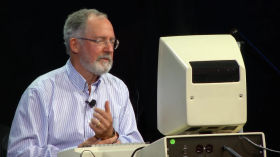
Demonstration and discussion of the programming language and environment "Smalltalk-76” with Dan Ingalls.
Source: https://youtu.be/NqKyHEJe9_w
(2017) A Brief History of Prototypes : Kat Marchán
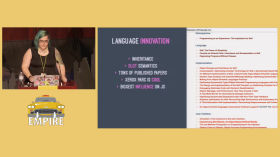
Source: https://youtu.be/vMlS4NscEvc
(2017) Stories From the Future of Democracy : Taiwan - Audrey Tang
Audrey Tang, hacker turned Digital Minister shares stories of the dramatic transformations underway to upgrade internet democracy in Taiwan. Civic hackers are supporting activists, voters and political leaders with a constantly refined set of online tools that allows them to share information, mobilize and participate in decision-making.
Source: https://youtu.be/5DkhUO7LiGs
(2017) The Most Beautiful Program Ever Written : William Byrd
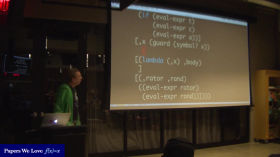
William E. Byrd "explores what he considers to be the most beautiful program ever written---a Lisp interpreter written in Lisp---and a few of the many amazing ideas related to this metacircular interpreter."
Source: https://youtu.be/OyfBQmvr2Hc
(2017) So You Want to Be a Wizard : Julia Evans
Transcript: https://jvns.ca/blog/so-you-want-to-be-a-wizard/
Source: https://youtu.be/qj2j93L9564
(2016) Limits of Logic : The Gödel Legacy - Douglas Hofstadter
Kurt Gödel showed that mathematical thinking cannot be captured in a formal axiomatic reasoning system. What does this deep result mean in practice? What are the limits of computer thinking? Can beauty and creativity and a sense of humor be formalized?
Source: https://youtu.be/V9ohtKameio
(2016) A delightful way to teach kids about computers : Linda Liukas

Computer code is the next universal language, and its syntax will be limited only by the imaginations of the next generation of programmers. Linda Liukas is helping to educate problem-solving kids, encouraging them to see computers not as mechanical, boring and complicated but as colorful, expressive machines meant to be tinkered with. In this talk, she invites us to imagine a world where the Ada Lovelaces of tomorrow grow up to be optimistic and brave about technology and use it to create a new world that is wonderful, whimsical and a tiny bit weird.
Source: https://archive.org/details/LindaLiukas_2015X
(2015) I Play The JavaScript : Matt McKegg
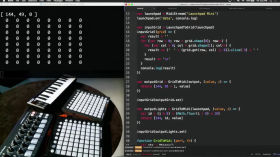
A JavaScript hacker and backyard musician and from Wellington, NZ. Lover of all things open and modular. I spend most of my time pressing buttons of various shapes, sizes and colours. Sometimes these buttons make sounds.
Source: https://youtu.be/NL0nb8A8FDM
(2015) How to read code : Aria Stewart
We learn and are taught to write software, and a lot of time and effort and research has been put into how to do this well, to varying degrees of success. We learn to evaluate libraries based on external factors like tests and documentation, but often we skip the most obvious part. How do we read source code?
Source: https://youtu.be/-KgU5sxGtuM
(2014) Turning the database inside out : Martin Kleppmann
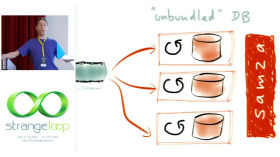
Databases are global, shared, mutable state. That's the way it has been since the 1960s, and no amount of NoSQL has changed that. However, most self-respecting developers have got rid of mutable global variables in their code long ago. So why do we tolerate databases as they are? --- A more promising model, used in some systems, is to think of a database as an always-growing collection of immutable facts. You can query it at some point in time — but that's still old, imperative style thinking. A more fruitful approach is to take the streams of facts as they come in, and functionally process them in real-time.
Source: https://youtu.be/fU9hR3kiOK0
(2013) Finding a Way Out : Chris Granger
Chris Granger attempts to imagine what programming would look like if it was created today.
Source (with slides): https://www.infoq.com/presentations/reimagining-software/
(2013) What Is a Strange Loop and What is it Like To Be One? - Douglas Hofstadter
[ ](https://tube.arthack.nz/videos/watch/f3132efc-dec
