
KP3D
Code for "Self-Supervised 3D Keypoint Learning for Ego-motion Estimation"
Install / Use
/learn @TRI-ML/KP3DREADME
Self-Supervised 3D Keypoint Learning for Ego-Motion Estimation
Accepted as Plenary talk at CoRL 2020.
Overview
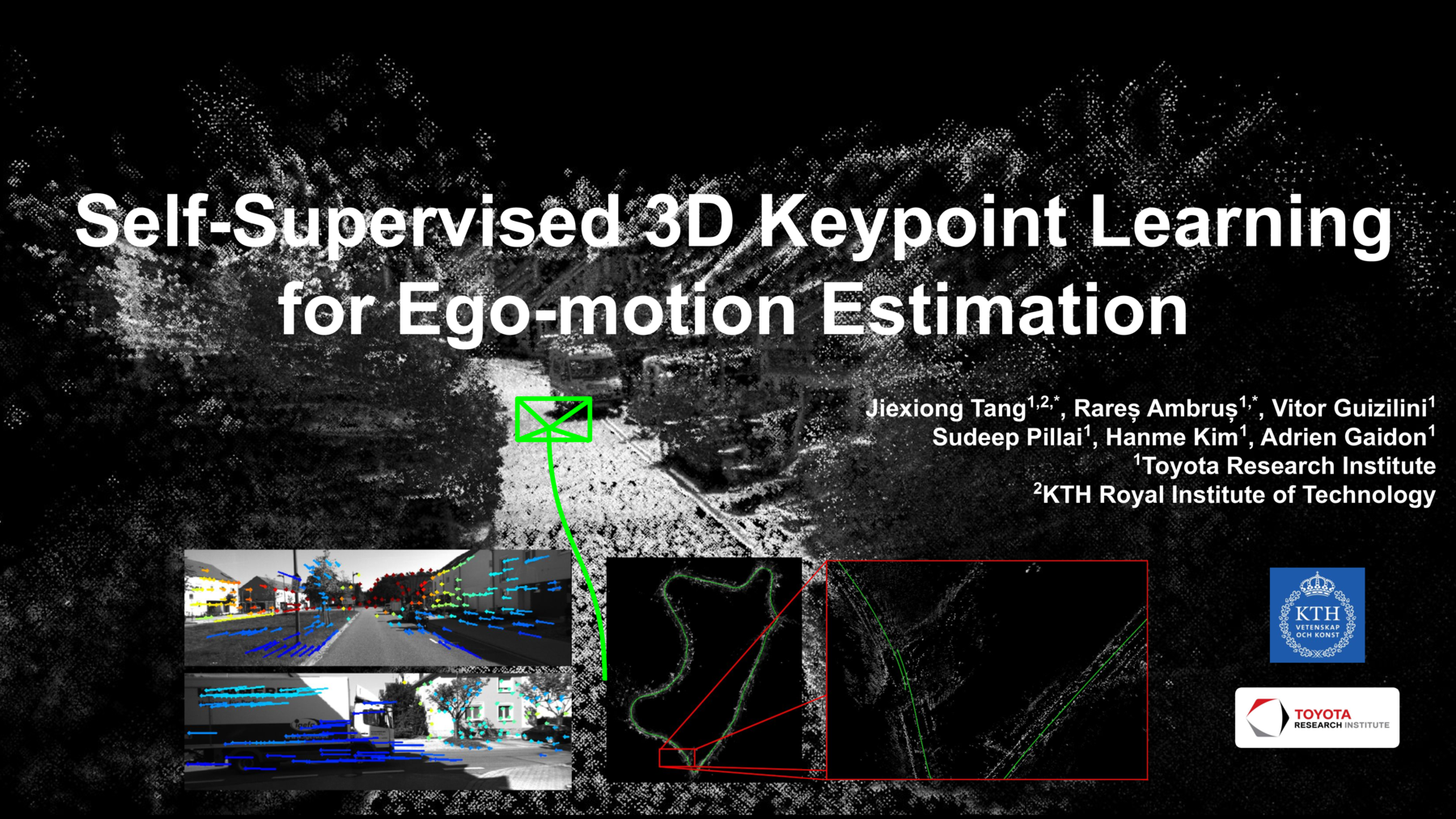
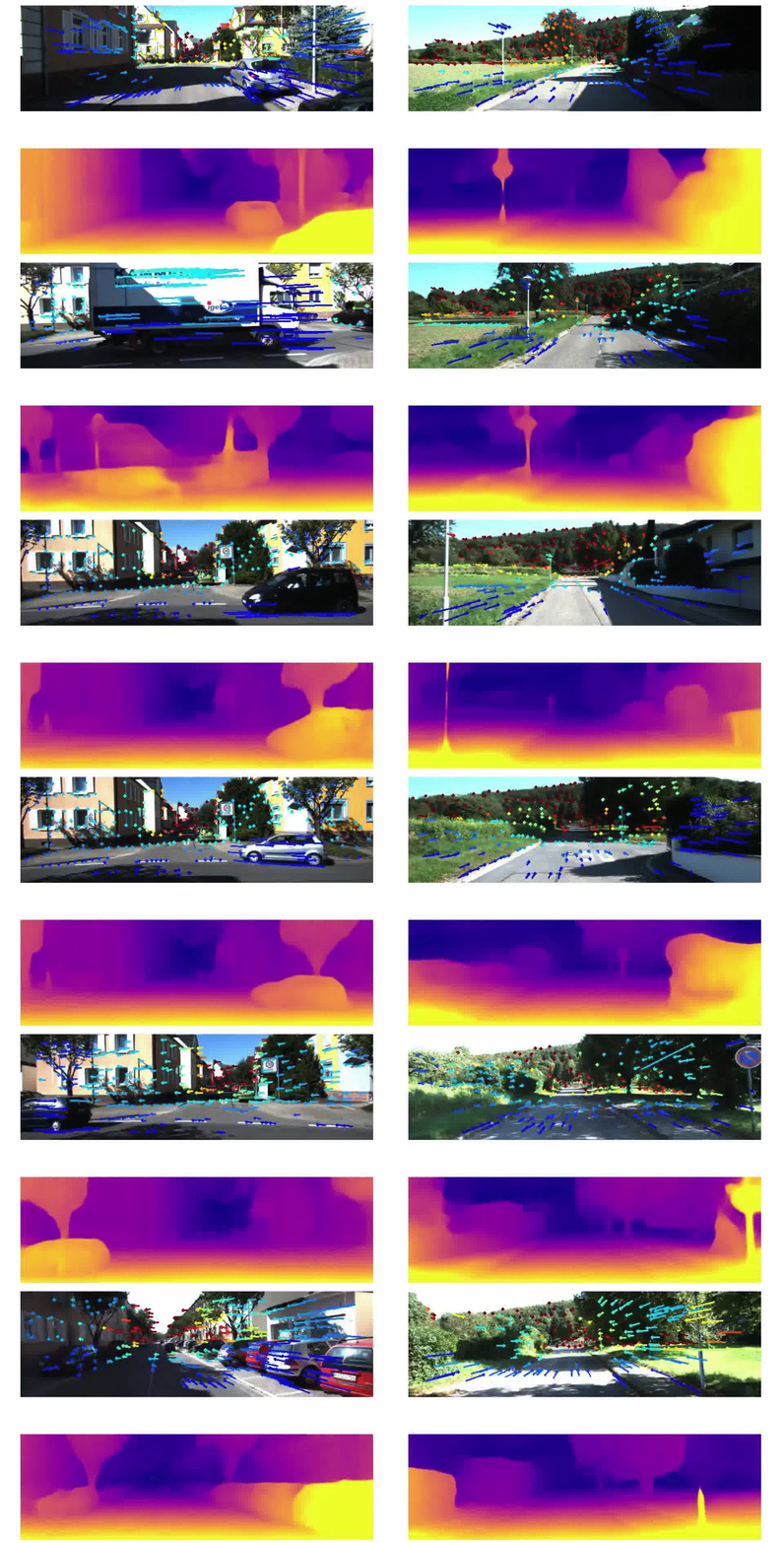
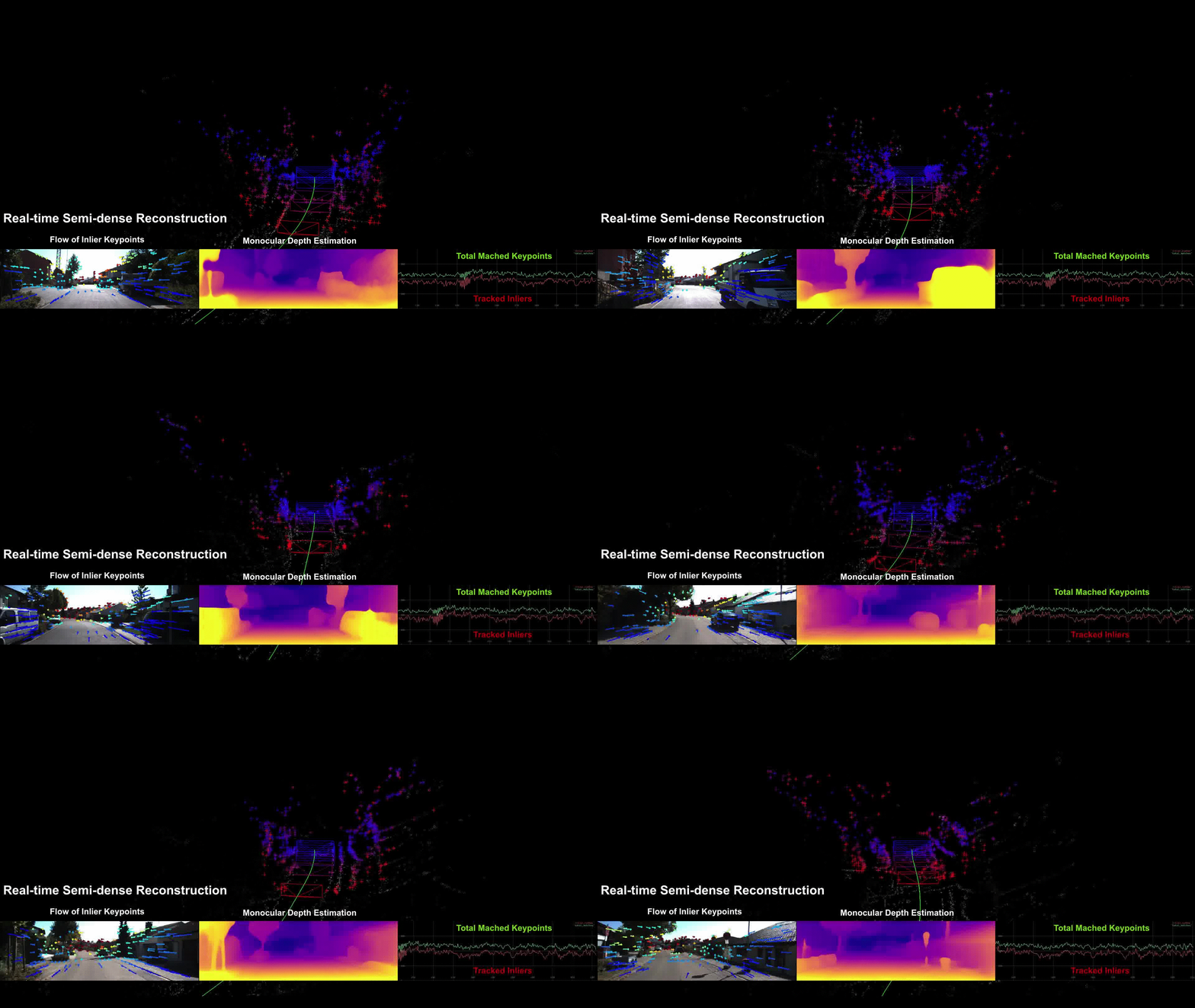
- Sparse mono-SfM: A new framework for the simultaneous learning of keypoint detection, matching and 3D lifting by incorporating a differentiable pose estimation module.
- Multi-view adaptation: A novel adaptation technique that exploits the temporal context in videos to further boost the repeatability and matching performance of the keypoint network.
- State-of-the-art performance: We integrate the networks into a visual odometry framework, enabling robust and accurate ego-motion estimation results
Setting up your environment
You need a machine with recent Nvidia drivers and a GPU. We recommend using docker (see nvidia-docker2 instructions) to have a reproducible environment. To setup your environment, type in a terminal (only tested in Ubuntu 18.04):
git clone https://github.com/TRI-ML/KP3D.git
cd KP3D
# if you want to use docker (recommended)
make docker-build
We will list below all commands as if run directly inside our container. To run any of the commands in a container, you can either start the container in interactive mode with make docker-start to land in a shell where you can type those commands, or you can do it in one step:
# single GPU
make docker-run COMMAND="some-command"
# multi-GPU
make docker-run-mpi COMMAND="some-command"
Data
Download the HPatches dataset for evaluation:
cd /data/datasets/kp3d/
wget http://icvl.ee.ic.ac.uk/vbalnt/hpatches/hpatches-sequences-release.tar.gz
tar -xvf hpatches-sequences-release.tar.gz
mv hpatches-sequences-release HPatches
Download the KITTI odometry dataset from here - get the color images and ground truth poses. Unzip the data in /data/datasets/kp3d/KITTI_odometry/.
Pre-trained models:
Download the pre-trained models from here and place them in /data/models/kp3d/.
To replicate our results on the KITTI odometry dataset (Table 1 - Ours), run:
make docker-run-mpi COMMAND="python kp3d/evaluation/evaluate_keypoint_odometry.py --depth_model /data/models/kp3d/depth_resnet.ckpt --keypoint_model /data/models/kp3d/keypoint_resnet.ckpt --dataset_dir /data/datasets/kp3d/KITTI_odometry/dataset/ --output_dir ./pose_output/ --sequence 01 02 06 08 09 10 00 03 04 05 07 --align_trajectory --run_evaluation"
You should get the following results:
| Sequence | 01 | 02 | 06 | 08 | 09 | 10 | 00 | 03 | 04 | 05 | 07 | Mean Train | Mean Test | |---|---|---|---|---|---|---|---|---|---|---|---|---|---| t_rel | 17.60 | 3.22 | 1.84 | 3.05 | 2.73 | 5.08 | 2.73 | 3.03 | 2.21 | 3.53 | 2.42 | 5.58 | 2.79 | r_rel | 0.62 |1.01 |0.75 | 0.73 | 0.63 | 0.97 | 1.09 | 2.42 | 1.97 | 1.18 | 1.00 | 0.79 | 1.53 |
To replicate our results on the HPatches dataset (Table 4 - KeypointNet), run:
make docker-run COMMAND="python kp3d/evaluation/evaluate_keypoint_patches.py --pretrained_model /data/models/kp3d/keypoint_resnet.ckpt --input /data/datasets/kp3d/HPatches/"
You should get the following results:
Evaluation for (320, 256):
| Repeatability | Localization | C1 | C3 | C5 | MScore | |---|---|---|---|---|---| | 0.686 | 0.800 | 0.514 | 0.867 | 0.914 | 0.588 |
Evaluation for (640, 480):
| Repeatability | Localization | C1 | C3 | C5 | MScore | |---|---|---|---|---|---| | 0.674 | 0.886 | 0.526 | 0.857 | 0.921 | 0.535 |
The numbers deviate slightly from the paper, due to different dependency versions.
Trajectories
Trajectories of DS-DSO on KITTI odometry sequences 00-10: ds_dso_kitti_00_10.zip. We also include the results of our ablative analysis as well as our evaluation of monodepth2.
<p align="center"> <img src="media/plots/seq05.png" alt="trajectory seq05" width="600" /> <img src="media/plots/seq07.png" alt="trajectory seq07" width="600" /> </p>License
The source code is released under the MIT license.
Citation
Please use the following citation when referencing our work:
@inproceedings{tang2020kp3d,
  title = {{Self-Supervised 3D Keypoint Learning for Ego-Motion Estimation}},
  author = {Jiexiong Tang and Rares Ambrus and Vitor Guizilini and Sudeep Pillai and Hanme Kim and Patric Jensfelt and Adrien Gaidon},
  booktitle={Conference on Robot Learning (CoRL)},
  year={2020},
}
