
Neuroweb
NeuroWeb Network is a decentralized Artificial Intelligence blockchain designed to incentivise knowledge creation, connectivity and sharing through Knowledge Mining.
Install / Use
/learn @OriginTrail/NeurowebREADME
NeuroWeb Node
<div align="center"> <img src="https://140069760-files.gitbook.io/~/files/v0/b/gitbook-x-prod.appspot.com/o/spaces%2FqMnH71Mmd7Au6HK5UAji%2Fuploads%2FEmgmn8pgCqu9eJaQPNSO%2FNeuroWeb%20X%20visual%20(1).jpg?alt=media&token=320f5009-0932-4ecc-a5a6-3bbb7a56cf45">




NeuroWeb Network is a decentralized Artificial Intelligence blockchain designed to incentivise knowledge creation, connectivity and sharing through Knowledge Mining. It's utility token NEURO is designed to fuel the AI knowledge economy, rewarding relevant knowledge contributions to the OriginTrail Decentralized Knowledge Graph.
- NeuroWeb builds on the basis of its predecessor - the OriginTrail Parachain - which was transformed into NeuroWeb via a community Governance vote on OriginTrail Parachain in December 2023.
- NeuroWeb is a permissionless, EVM enabled blockchain secured by Polkadot validators.
- NeuroWeb node is built with Substrate framework.
Build & Run
Follow these steps to prepare a local Substrate development environment :hammer_and_wrench:
Setup of Machine
If necessary, refer to the setup instructions at the Substrate Developer Hub.
Build
Once the development environment is set up, build the parachain node template. This command will build the Wasm Runtime and native node code:
cargo build --release
Run a network
To run a full network with multiple NeuroWeb nodes (collators and non-collators), first we need to start relay chain, and after that our parachain.
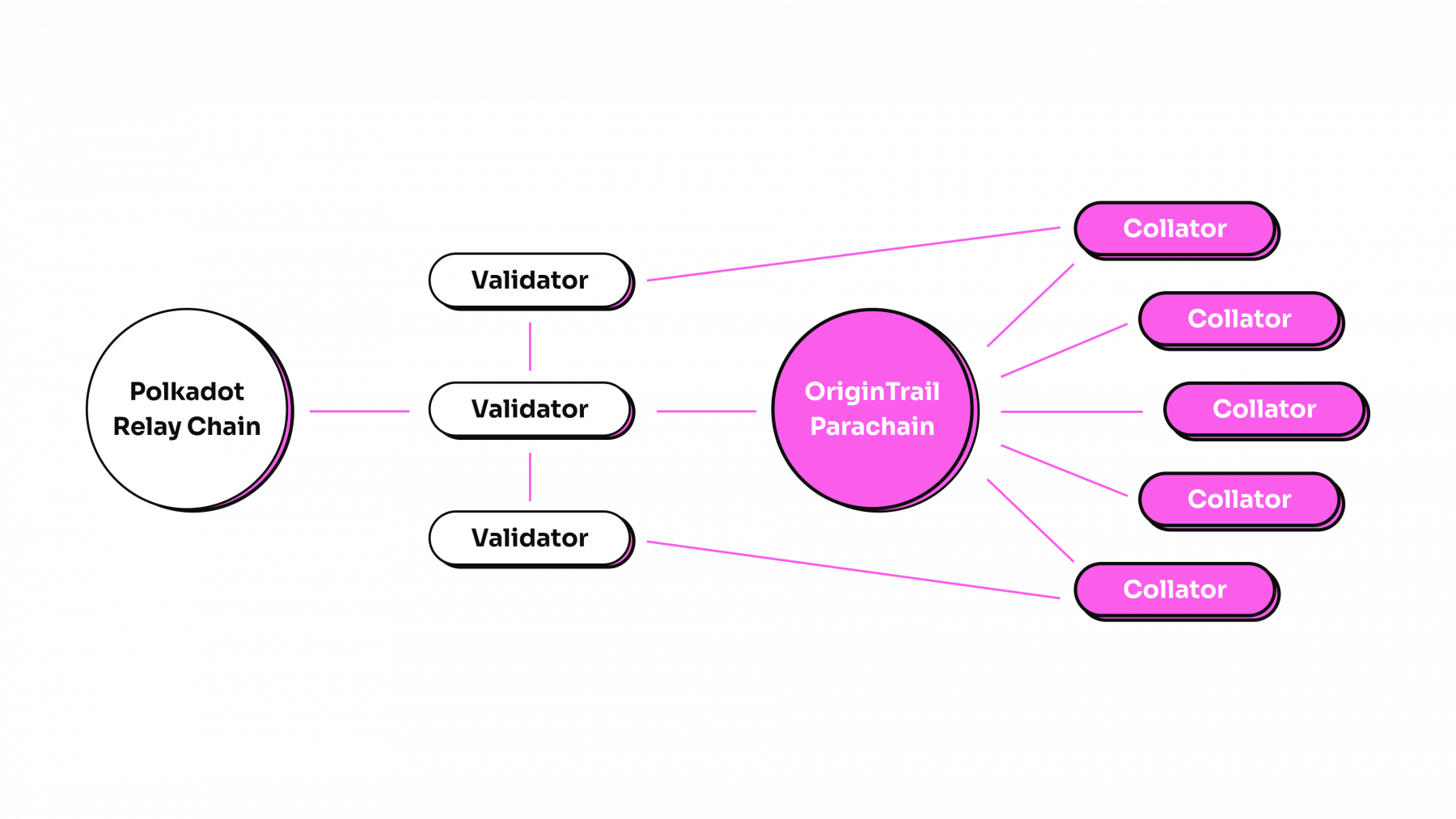
Run A Relay Chain
To start a relay chain we recommend reading and following instructions in Cumulus Workshop. NeuroWeb is currently compatible with Polkadot v1.11.0 version.
Parachain Nodes (Collators)
From the OriginTrail parachain working directory:
# NOTE: this command assumes the chain spec is in a directory named `polkadot`
# that is at the same level of the template working directory. Change as needed.
./target/release/origintrail-parachain \
-d cumulus-parachain/alice\
--local \
--collator\
--alice\
--ws-port 9945\
--parachain-id 2000\
--\
--execution wasm\
--chain ../polkadot/rococo_local.json
Then you need to register on Local Relay Chain as it is presented in Cumulus Workshop. For registering we first need to export the Parachain Genesis and Runtime.
# Build the Chain spec
./target/release/origintrail-parachain build-spec\
--disable-default-bootnode > ./template-local-plain.json

# Build the raw file
./target/release/origintrail-parachain build-spec \
--chain=./resources/template-local-plain.json \
--raw --disable-default-bootnode > ./resources/template-local.json

# Export genesis state to `./resources files
./target/release/origintrail-parachain export-genesis-state --parachain-id 2000 > ./para-2000-genesis
# export runtime wasm
./target/release/origintrail-parachain export-genesis-wasm > ./para-2000-wasm
In order to produce blocks you will need to register the parachain as detailed in the Substrate Cumulus Workshop by going to:
Developer -> sudo -> paraSudoWrapper -> sudoScheduleParaInitialize(id, genesis)
Ensure you set the ParaId to 2000 and the parachain: Bool to Yes.
Containerize
Build
docker build -t origintrail-parachain .
Run
docker run -it -p 30333:30333 -p 9933:9933 -p 9944:9944 -p 9615:9615 -v /data:/data origintrail-parachain:latest\
  --base-path=/data --rpc-external --ws-external\
  --ws-max-connections=1000 --rpc-cors=all\
  --prometheus-external --rpc-methods=Unsafe\
  --chain=/config/origintrail-parachain-2043-raw.json\
  --no-mdns --execution=wasm --pruning=archive\
  -- --execution=wasm --wasm-execution=Compiled --chain=polkadot
Developers
Local Fork with Chopsticks
Neuroweb + Relay Chain:
npx @acala-network/chopsticks@latest --config=neuroweb

# For testnet use
npx @acala-network/chopsticks@latest --config=neuroweb-testnet
Neuroweb + Relay Chain + Hydration + Asset Hub:
npx @acala-network/chopsticks@latest xcm -r polkadot -p neuroweb -p hydradx -p polkadot-asset-hub
Neuroweb (local config with WASM override) + Relay Chain:
npx @acala-network/chopsticks@latest --config=launch-configs/chopsticks/neuroweb.yml
Local fork with Zombienet
Prerequisites:
- Install Zombienet
- Clone and build the appropriate version of the Polkadot runtime in the parent directory
- Build the Neuroweb runtime
cd launch-configs/zombienet
zombienet spawn neuroweb-local.json
Related Skills
diffs
340.2kUse the diffs tool to produce real, shareable diffs (viewer URL, file artifact, or both) instead of manual edit summaries.
clearshot
Structured screenshot analysis for UI implementation and critique. Analyzes every UI screenshot with a 5×5 spatial grid, full element inventory, and design system extraction — facts and taste together, every time. Escalates to full implementation blueprint when building. Trigger on any digital interface image file (png, jpg, gif, webp — websites, apps, dashboards, mockups, wireframes) or commands like 'analyse this screenshot,' 'rebuild this,' 'match this design,' 'clone this.' Skip for non-UI images (photos, memes, charts) unless the user explicitly wants to build a UI from them. Does NOT trigger on HTML source code, CSS, SVGs, or any code pasted as text.
openpencil
1.9kThe world's first open-source AI-native vector design tool and the first to feature concurrent Agent Teams. Design-as-Code. Turn prompts into UI directly on the live canvas. A modern alternative to Pencil.
HappyColorBlend
HappyColorBlendVibe Project Guidelines Project Overview HappyColorBlendVibe is a Figma plugin for color palette generation with advanced tint/shade blending capabilities. It allows designers to
