
crbro-memory
Local, persistent memory for AI agents (MCP server). Plain JSON on your disk; fact-level search with an optional local semantic layer; corrections replace old facts; stale-value warnings; secrets kept out; a browser page to read, edit and merge it.
Install / Use
claude mcp add Octonove -- npx -y github:Octonove/crbro-memoryIf the server publishes to npm under a different name, use that package instead — check the repo README.
MCP Server
Model Context Protocol server
Quality Score
Category
Development & EngineeringSupported Platforms
Tags
Our assessment of crbro-memory
crbro-memory scores 76/100 on our quality scale, 3753rd of 4,721 Development & Engineering skills we index.
Its MCP Server is 35 KB long, well organised into 26 sections with 8 code examples: a thorough specification that gives an agent plenty to work with.
It has 10 GitHub stars, so there is little community track record yet; judge it on its content.
Maintenance, license and trust
- The repository was last updated 6 days ago, so crbro-memory is actively maintained.
- It is released under the MIT license, a permissive license that allows use, modification and commercial use with attribution.
- Its trust signals score 97/100, with no cautions. These come from repository metadata, not a code audit — read the skill file before letting an agent act on it.
crbro-memory compared with similar skills
All 4 of these similar skills score higher than crbro-memory; compare them before choosing.
| Skill | Score | Stars | Updated | Format |
|---|---|---|---|---|
| crbro-memory (this skill)by Octonove | 76 | 10 | 6d ago | MCP Server |
| taste-skillby Leonxlnx | 100 | 122.4k | 1d ago | CLAUDE.md |
| Agent-Reachby Panniantong | 100 | 115.5k | 3d ago | CLAUDE.md |
| hyperframesby heygen-com | 100 | 91.7k | today | CLAUDE.md |
| rufloby ruvnet | 100 | 82.6k | today | CLAUDE.md |
Frequently asked questions
- How do I install crbro-memory?
- Run
claude mcp add Octonove -- npx -y github:Octonove/crbro-memory. The install tabs above show the steps for each supported agent. - Which AI agents does crbro-memory work with?
- It is written for Claude Code, Claude Desktop, Cursor and OpenAI Codex, as a MCP Server file. Other agents that read the same format can often use it too.
- Is crbro-memory safe to use?
- It is MIT-licensed and scores 97/100 on trust signals. Skills are instructions an agent will follow, so read the file before installing it and do not approve commands you do not understand.
- Is crbro-memory still maintained?
- The repository was last updated 6 days ago, so crbro-memory is actively maintained.
Skill content
View source on GitHub🧠 CRBRO — Persistent Neural Memory for AI






CRBRO is a local MCP (Model Context Protocol) server that gives your AI assistant persistent long-term memory across sessions: what you decided, how things are deployed, what is still pending. Everything is plain JSON on your own disk, organized like a brain — cortex, synapses, hippocampus. A correction replaces the old fact instead of sitting next to it, an old value comes back with a warning to check it, a question with nothing stored behind it is answered as such, and credentials are kept out. You can read and edit all of it in your browser, and one command installs it in Claude Code, Claude Desktop, Codex and Cursor.
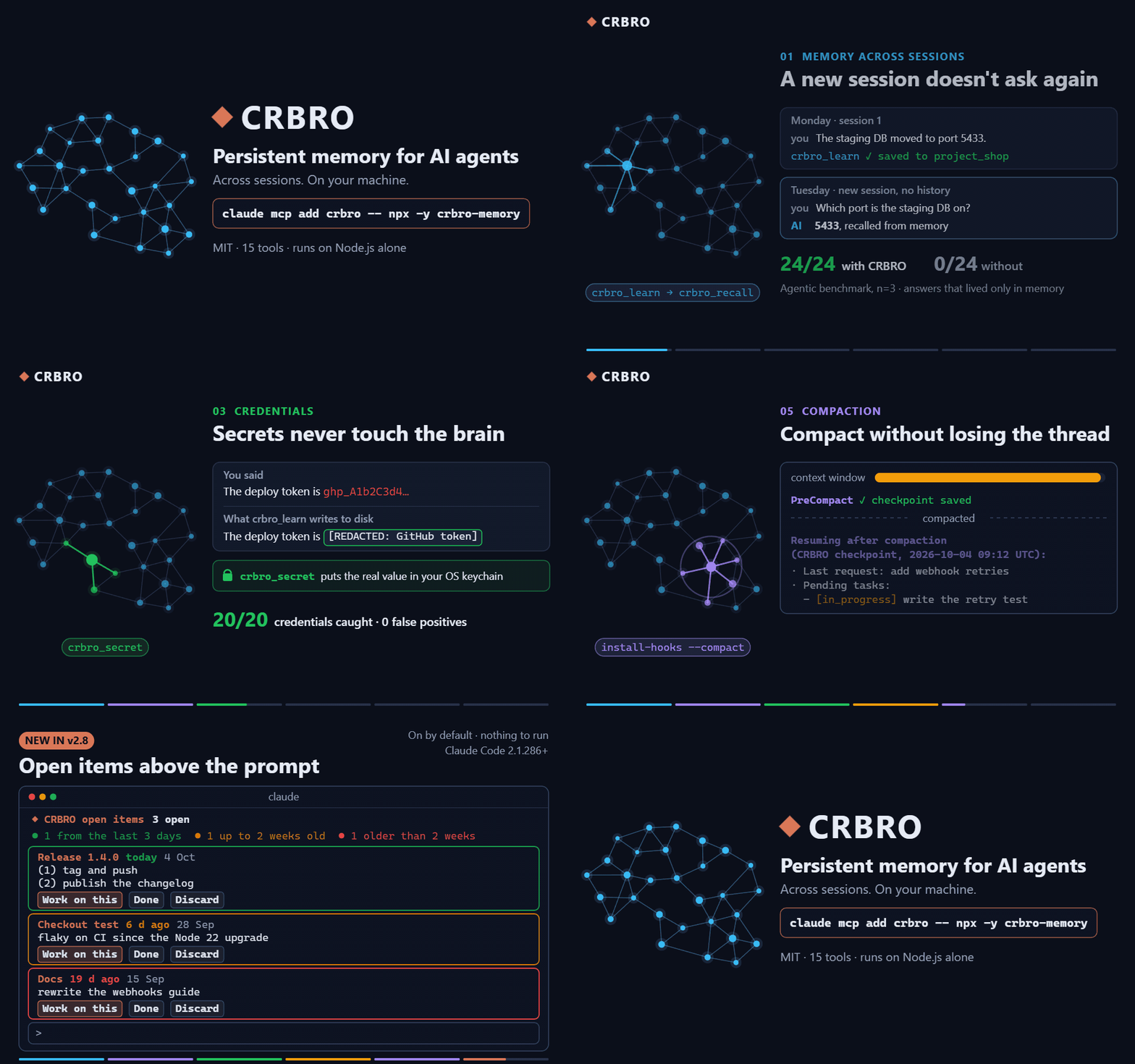
Free and open source (MIT). All 15 tools included — no license, no account, no tiers.
This page has three layers. 1. Quick start gets you running in a minute. 2. Reference lists the tools, the commands and the environment variables. 3. Measurements says what it costs and how well it works, with dates. Troubleshooting covers the problems people actually hit.
1. Quick start
You need Node.js 20 or later (the Claude Desktop bundle below needs none).
Claude Desktop: one double click
Download the .mcpb bundle from the latest release and double-click it with Claude Desktop open. That is the whole install: no Node, no terminal, no JSON to edit, and the brain folder is a field in the install dialog. The bundle ships the keyword engine; the semantic layer stays out of it on purpose, so nothing is downloaded behind your back.
Every other client: one command
npx crbro-memory install
It finds the MCP clients on this machine (Claude Code, Claude Desktop, Cursor, Codex), copies the engine to one stable folder (~/.crbro-engine/<version>, or --engine-dir DIR), registers node <that folder>/crbro.mjs in each client with the timeouts that client needs, and makes the memory load itself at the start of every conversation. No npx at client start, so every client runs the same build and shares one daemon. It merges into your config files and never rewrites them: every file it touches keeps a timestamped backup beside it (<file>.crbro-bak-<stamp>). Pick clients with --clients claude-code,codex (default auto), see what it would do first with --dry-run, and get the report as JSON with --json. npx crbro-memory uninstall takes the same flags and removes only what CRBRO added — never the brain (complete uninstall).
Then restart the client, open a new conversation, and check that crbro_boot actually ran and returned a neuron count. npx crbro-memory doctor is a read-only check of what is installed where.
Installing the server does not call it. The tools are there, the brain is on disk, and nothing reads it: the assistant answers from nothing and the memory looks broken when it is merely asleep. Every "CRBRO doesn't remember" report so far has been this, not a bug in recall. The
installcommand above wires the start for you; the manual route is below.
Registering by hand
Prefer to edit config yourself? Register CRBRO at the user level, not per-project: the brain lives in ~/.crbro/ and is shared across every folder, but a server registered inside one project is missing everywhere else and it will look like the memory is gone.
Claude Code (one command, available in every folder):
claude mcp add --scope user crbro -- npx -y crbro-memory
Claude Desktop — %APPDATA%\Claude\claude_desktop_config.json on Windows, ~/Library/Application Support/Claude/claude_desktop_config.json on macOS, ~/.config/Claude/claude_desktop_config.json on Linux:
{
  "mcpServers": {
    "crbro": {
      "command": "npx",
      "args": ["-y", "crbro-memory"]
    }
  }
}
Cursor — ~/.cursor/mcp.json (the one in your home folder, not a project's .cursor/): same JSON as above.
Codex — ~/.codex/config.toml. Give it a startup timeout: Codex starts MCP servers when a session opens and gives up after a short default (see Troubleshooting).
[mcp_servers.crbro]
command = "npx"
args = ["-y", "crbro-memory"]
startup_timeout_sec = 60
tool_timeout_sec = 120
install and install-boot add these two lines only when they are missing; values you set yourself are kept.
Docker (the brain lives in /root/.crbro; mount a volume to keep it. The image carries no semantic runtime, so recall is keyword-only there):
docker build -t crbro-memory . && docker run -i -v crbro-brain:/root/.crbro crbro-memory
Making it load itself, by hand
npx crbro-memory install-boot
install-boot wires the start into whichever clients it finds, merging into your config and never rewriting it. It is idempotent, and it leaves alone any hook you already wrote yourself:
| Client | What it writes |
|---|---|
| Claude Code | SessionStart in ~/.claude/settings.json — a command whose stdout enters the session telling the model to call crbro_boot first. Claude Code cannot invoke an MCP tool from a hook, so the instruction is the mechanism. |
| Codex | SessionStart in ~/.codex/hooks.json — an mcp_tool step that calls crbro_boot directly, plus the same printed instruction as a second layer. The hook can fire before the MCP server has finished starting, and then the direct call is simply lost; the instruction covers that window. |
Tools without session hooks (Cursor, Windsurf, Antigravity…) do the same job from their always-on rules file — .cursorrules, .windsurfrules, User Rules. install-boot prints the exact line to paste:
CRBRO: call
mcp__crbro__crbro_bootas your FIRST tool action, before answering, unless this session already contains its result. Apply theprotocol_enforcementblock it returns for the rest of the session.
Semantic recall (optional)
npx crbro-memory init creates the brain and installs a local embedding model that is fused with the keyword engine, so paraphrases the words do not cover start to land. It is a download of several hundred MB once per machine (sizes and timings in Measurements); init --no-semantic skips it and CRBRO_SEMANTIC=0 turns it off any time. Details: docs/semantic-recall.md.
Using it
Your AI now has 15 memory tools and boots the brain on its own. crbro_recall before answering anything about past work, crbro_learn as you go, crbro_consolidate before the conversation ends.
To see what it knows, npx crbro-memory view opens a local page (127.0.0.1, one-time token) where you search the memory, edit or retire an entry, merge two neurons and close open items. npx crbro-memory export writes it all out as Markdown or JSON, and npx crbro-memory import brings in a CLAUDE.md / AGENTS.md, a Claude Code memory folder or an export (a dry run unless you pass --apply).
More that you can switch on, each in docs/hooks.md and docs/daemon.md: the guard hook (stored lessons speak before a shell command runs), the compaction checkpoint, the subagent hook, the open-items band in Claude Code, and the daemon for several clients on one brain.
2. Reference
The 15 tools
| Tool | Description |
|------|-------------|
| crbro_boot | Boot the brain at session start — loads hot topics, context, the last three sessions and the retired_tools map. project (the folder or repo name) puts that project's neurons first and lists them in project_neurons |
| crbro_inspect | Read-only views by id or name: view=status (with the version the process runs, and the one installed on disk when npx replaced it under a running process), neuron, neurons, sessions, global_map. view=neuron is an index by default — every entry as id, kind, date and preview; entries=[ids] reads those in full, detail=full the whole neuron. view=sessions session=<id> reads one day log whole |
| crbro_learn | Store a fact, decision, pattern, preference, error or debt with search keywords. supersedes replaces old facts; shelf_life, reference and temporal describe the claim. Repeating it never verifies it; use an explicit crbro_revise status=verified with evidence after a real check |
| crbro_recall | Search every stored line, not just topic names — returns what matched, how confidently, and the topic's next best lines. Several phrasings at once are fused by rank; since ("2026-09-01", "2w") and kind (["error"]) narrow it; sessions_matched lists the day logs that mention it. A line that is not yours says where it came from (origin). A row past its shelf life comes back apart, in possibly_stale, with what to check before answering |
| crbro_revise | Retire facts (and decisions, patterns, errors, debts via entries) as superseded or retracted, reactivate them with status=active, reconfirm checked ones with status=verified, edit summary, domain, tags or name, and split a neuron with move_to — the entries keep their dates |
| crbro_forget | Remove for good, keeping a copy in .quarantine/ first — entries of a neuron, a whole neuron (two-step with confirm_token), a session log; restore and merge_into too |
| crbro_connect | Create, strengthen, set the strength of or delete (action=disconnect) a connection between neurons |
| crbro_context | Read (no arguments) or update the active working context — topics, open items, discard or clear |
| crbro_map | Keep one living map of how a topic's system works — replaced whole, never patched |
| crbro_consolidate | End-of-session consolidation — the only way to log a session; links the topics it wrote and syncs spaces. promotion_candidates: lessons this session's projects share with other projects — suggested, never moved |
| crbro_maintenance | Brain maintenance — heat, pruning, integrity, repair, unarchive, index rebuild. Every run reports expired entries, entries past their shelf life, oversized neurons and bulk-import leftovers; backfill_dates and compact act on them |
| crbro_audit | Find credentials stored in the brain, session logs included — reports the kind, never the value |
| crbro_secret | Put a credential in the OS keychain and keep only its name in the brain. See docs/credentials.md |
| crbro_space | Create, join, sync or leave a team space — a private git repo for shared projects. See docs/team-memory.md |
| crbro_share | Put one project into a space, after showing exactly what would be sent; unshare stops following it |
A 1.x brain opens as it is: s
Truncated for display — read the full file on GitHub.
Related Skills
taste-skill
122.4kAgent skills that give coding agents taste: art direction, reference images and a browser check instead of generic AI pages
Agent-Reach
115.5kGive your AI agent eyes to see the entire internet. Read & search Twitter, Reddit, YouTube, GitHub, Bilibili, XiaoHongShu — one CLI, zero API fees.
hyperframes
91.7kOpen-source AI video editor: edit your own footage, or create and remake any video with Claude Code, Codex or the free Studio app. Write HTML, render MP4. By HeyGen.
ruflo
82.6k🌊 The original agent harness. Deploy intelligent multi-player swarms, coordinate autonomous workflows, and build conversational AI systems. Features adaptive memory, self-learning intelligence, federation, vector RAG integration, and native Claude Code / Codex / Hermes and many more Integrated

Languages
Trust signals
From repository metadata: license, adoption, age and documentation. Not a code audit — see the Safety scan above for what the skill file itself contains.