
TechStacks
TechStacks Web App created using Nuxt.js + Vuetify
Install / Use
/learn @NetCoreApps/TechStacksREADME
TechStacks
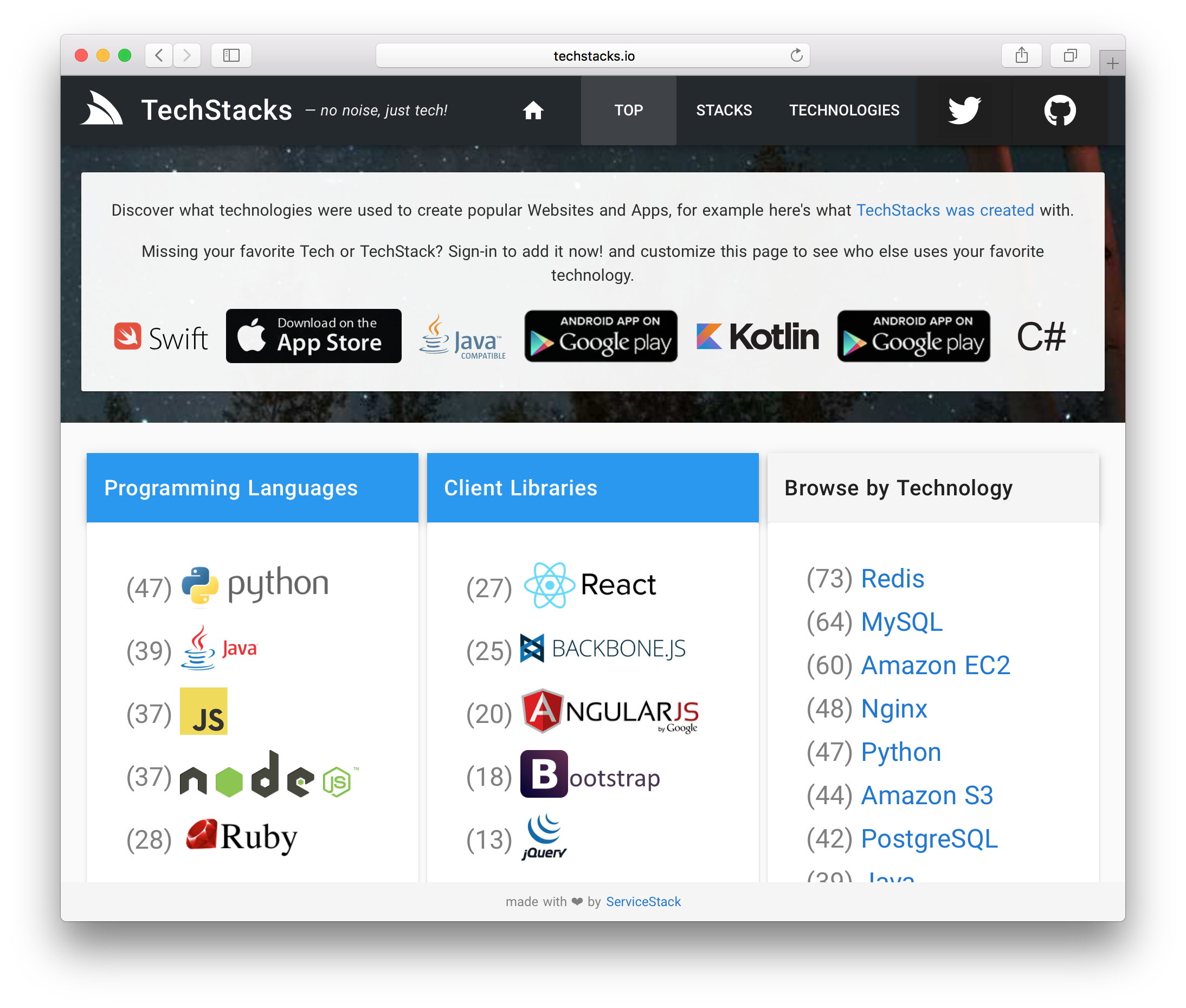
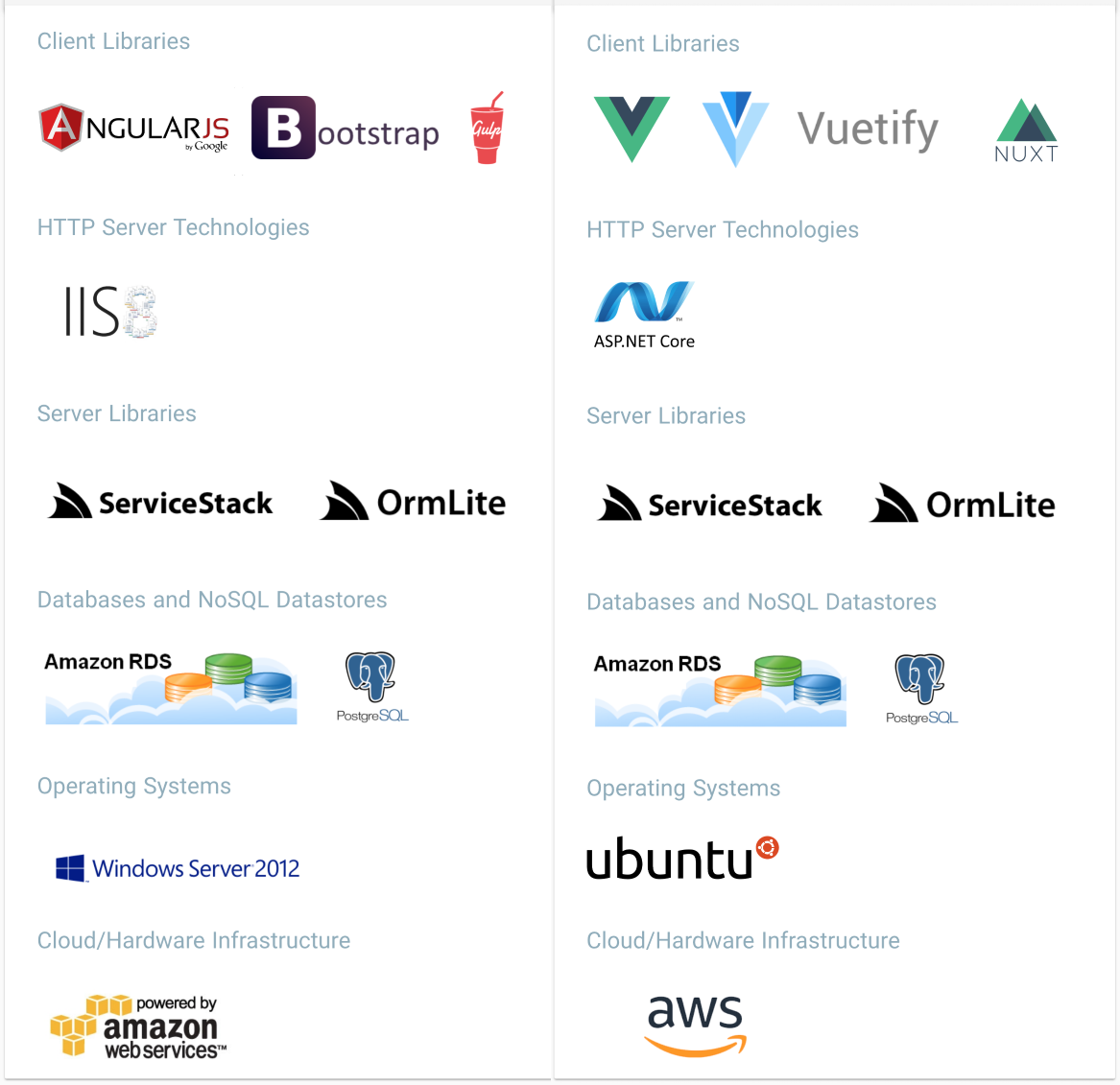
Given the impressive development velocity enabled by the Nuxt and Vuetify power combo, we decided to rewrite https://techstacks.io using it. The original TechStacks website was built in 2014 with what was considered the state-of-the-art Technology Stack for .NET SPA at the time: i.e. Angular 1.x / Bootstrap Website hosted on .NET's recommended system software of ASP.NET / IIS / Windows Server.
A lot has changed since then, in both the JavaScript and .NET Server ecosystems. Angular 1.x was surpassed by a complete rewrite of Angular 2+ in TypeScript in its latest version. During that time both have since been eclipsed in popularity by React and Vue with nearly 3x the popularity by stars on GitHub. We like React for true Single Page Apps like IDEs and what we used to develop Gistlyn. But for multi-page Apps we prefer Vue which has a higher fidelity and better encapsulation of HTML pages with its Single File Components.
Recommended .NET SPA Stack
Nuxt further enhances Vue with an opinionated convention-based framework that combines the most popular Vue libraries into a unified solution, perfect for multi-page Web Apps like TechStacks. Nuxt provides the prescribed architecture, development model and core functionality whilst Vuetify provides the UI Layout and comprehensive suite of UI Components - combining into an elegant solution that dramatically reduces the development and design effort to develop a Single Page Apps like TechStacks.
On the .NET side, .NET Core became the future platform for hosting .NET Apps with its leaner, faster and cross-platform runtime. It's ability to run flawlessly on Linux makes it our default choice for new projects where we readily take advantage of its superior automation and ecosystem.
Before and After
So given the current ecosystem we ported TechStacks to what we consider is the state-of-the-art Technology Stack for developing .NET Apps in 2018, starting from the .NET Core vuetify-nuxt Template. Visually the before/after Technology Stack for TechStacks is:
Resilience of ServiceStack
What's noteworthy about the development of the new TechStacks Website was that despite having a completely rewritten UI on the front-end, running on the new .NET Core Runtime and Linux Operating System on the back-end, the one thing that could be reused as-is was its Services implementation - which speaks to both the timelessness of ServiceStack's API Design for cleanly capturing the intent of its declarative Service Contracts and the near-perfect source-code compatibility with .NET Core - preserving and future-proofing existing ServiceStack investments by making it trivial to port to .NET Core as and when needed.
Also despite some existing tables being modified to support the expanded feature-set, the Old TechStacks Website continues to run, using the old OrmLite POCO Data Models to connect to the same database as the New TechStacks Website. This resilience also extends to the existing Swift TechStacks iOS App which continues to run unmodified despite now accessing enhanced modified Services that's now being proxied through Netlify's CDN. The primary disruptive change to Services was that they now use .NET Core's default camelCase property names which also doesn't impact existing iOS Mobile Apps thanks to the Swift JsonServiceClient supporting case-insensitive properties.
For comparison purposes we're continuing to host the old Website:
New TechStacks
- URL: techstacks.io
- Source Code: github.com/NetCoreApps/TechStacks
Old TechStacks
- URL: angular.techstacks.io
- Source Code: github.com/ServiceStackApps/TechStacks
Both code-bases are Open Source and provide a good reference of our preferences in developing a mildly complex medium-sized ServiceStack App which now exceeds 100 Services to support its expanded feature-set.
Netlify CDN
One of the goals for TechStacks is to develop an efficient implementation that maximizes the scalability of the App Server. Some of the techniques include utilizing PostgreSQL's rich data types to minimize/eliminate table joins, Indexes for popular queries, maintenance of manual caches of aggregate query results, simple response caching, etc.
Another strategy adopted to reduce the load off the App Server is to host the static Nuxt generated website in /wwwroot on Netlify's CDN as described above which is configured to proxy all API requests and built-in ServiceStack features using this _redirects file.
Whilst proxying provides the cleanest and most transparent solution, it can add a noticeable sub-second latency to API Requests so we've opted instead to enable CORS and have API Requests call the App Server directly, done by configuring 2 Service Clients:
const usingProxy = location.host == "techstacks.io";

const BaseUrl = usingProxy
    ? "https://www.techstacks.io/"  // .NET Core App Server on AWS LightSail
    : "/";

const AuthBaseUrl = usingProxy
    ? "https://techstacks.io/"      // Netlify
    : "/";

export const client = new JsonServiceClient(BaseUrl);
export const authClient = new JsonServiceClient(AuthBaseUrl);
Where https://techstacks.io serves the static website hosted from Netlify's CDN and https://www.techstacks.io serves content directly from the App Server via an nginx reverse proxy.
The different domains means we need to transfer the Authenticated Session that's attached to the techstacks.io domain by converting the Authenticated Session into a JWT Token that's sent to the App Server in parallel requests to retrieve the Authenticated User Info and convert the JWT Token into a Cookie so it's re-sent on every subsequent request to the App Server:
export const getSessionInfo = async() => {
    try {
        //Converts Session to JWT Token Cookie
        const authResponse = await authClient.post(new ConvertSessionToToken());

        client.bearerToken = authResponse.accessToken;
        const [response, authResponse2] = await Promise.all([
            client.get(new SessionInfo()),
            client.post(new ConvertSessionToToken()),
        ]);

        //Remove unnecessary JWT from HTTP Headers so only JWT Cookie is used
        client.bearerToken = authClient.bearerToken = null;
        client.headers.delete('Authorization');
        authClient.headers.delete('Authorization');

        return response;
    } catch (e) {
        return null;
    }
}
AWS LightSail
With these pro-active efficiency techniques we're confident in hosting on AWS's $5/mo LightSail Server which we're happy to see still yielding a fast and responsive User Experience. We'll monitor the resource usage and report back on how much load it can withstand before requiring a hardware bump.
ServiceStack Community Resources
One of the primary motivations for rewriting TechStacks was to create useful resource for the ServiceStack Community to be able to collaborate and contribute to as currently ServiceStack community content is scattered across several different sites:
- Questions/Issues/Discussion/Announcements on Discourse Forums
- Questions/Issues on StackOverflow
- Issues on GitHub
- Feature Requests on UserVoice
- Announcements on Twitter
- Discussion/Announcements on Google+
This situation is less than ideal as developers don't have a single resource they can frequent to find existing content and get in touch with the rest of the Community. There's also several things we dislike about all sites. Despite Discourse being one of the best forum software available we see a few issues with it like its search and discovery features aren't great, doesn't display threaded conversations well, not optimal for contributing developer content. StackOverflow is very strict about what content it will accept, lacks a welcoming community atmosphere and its markdown support isn't as good as GitHub Flavored Markdown. UserVoice is poor at moderation, editing and discussion, Twitter's only ideal for notifications and Google+ is poor at nearly all forms of rich content, discovery, threaded comments, etc.
None of the resources are particularly great at sharing community content like showcasing people's creations, blog posts, announcements or their preferred technology stacks they've used to create their Apps with - which is the kind of comm
Related Skills
node-connect
347.2kDiagnose OpenClaw node connection and pairing failures for Android, iOS, and macOS companion apps
frontend-design
108.0kCreate distinctive, production-grade frontend interfaces with high design quality. Use this skill when the user asks to build web components, pages, or applications. Generates creative, polished code that avoids generic AI aesthetics.
openai-whisper-api
347.2kTranscribe audio via OpenAI Audio Transcriptions API (Whisper).
qqbot-media
347.2kQQBot 富媒体收发能力。使用 <qqmedia> 标签,系统根据文件扩展名自动识别类型(图片/语音/视频/文件)。
