
Litstudy
LitStudy: Using the power of Python to automate scientific literature analysis from the comfort of a Jupyter notebook
Install / Use
/learn @NLeSC/LitstudyREADME
LitStudy






LitStudy is a Python package for analyzing scientific literature right from the comfort of a Jupyter Notebook. It lets you gather publications and explore their metadata through visualizations, network analysis, and natural-language processing.
The package offers five main features:
- Extract metadata from scientific documents sourced from various locations. A uniform interface allows combining different data sources.
- Filter, select, deduplicate, and annotate document collections.
- Compute and plot general statistics for document sets (authors, venues, publication years, and more).
- Generate and plot various bibliographic networks as interactive visualizations.
- Discover topics using natural-language processing (NLP) to automatically identify popular themes.
Frequently Asked Questions
If you have any questions or run into an error, see the Frequently Asked Questions section of the documentation. If your question or error is not on the list, please check the GitHub issue tracker for a similar issue or create a new issue.
Supported Source
LitStudy supports the following data sources. The table below lists which metadata is fully (✓) or partially (*) provided by each source.
| Name | Title | Authors | Venue | Abstract | Citations | References | |-----------------|-------|---------|-------|----------|----------------|------------| | Scopus | ✓ | ✓ | ✓ | ✓ | ✓ | ✓ | SemanticScholar | ✓ | ✓ | ✓ | ✓ | * <sup>(count only)</sup> | ✓ | CrossRef | ✓ | ✓ | ✓ | ✓ | * <sup>(count only)</sup> | ✓ | DBLP | ✓ | ✓ | ✓ | | | | arXiv | ✓ | ✓ | | ✓ | | | IEEE Xplore | ✓ | ✓ | ✓ | ✓ | * <sup>(count only)</sup> | | Springer Link | ✓ | ✓ | ✓ | ✓ | * <sup>(count only)</sup> | | CSV file | ✓ | ✓ | ✓ | ✓ | | | bibtex file | ✓ | ✓ | ✓ | ✓ | | | RIS file | ✓ | ✓ | ✓ | ✓ | |
Example
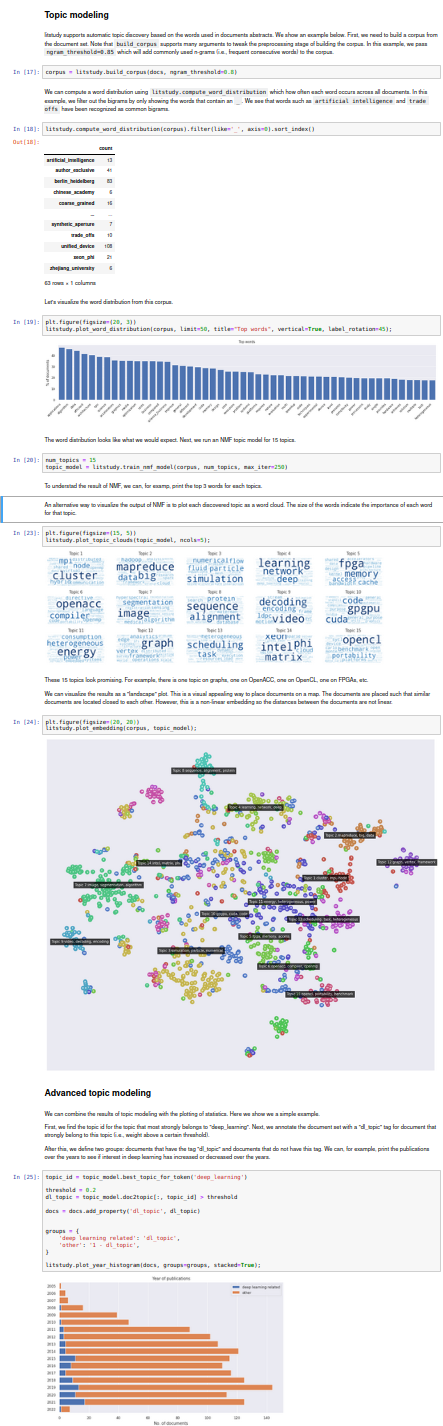
An example notebook is available in notebooks/example.ipynb and here.
Installation Guide
LitStudy is available on PyPI! Full installation guide is available here.
pip install litstudy
Or install the latest development version directly from GitHub:
pip install git+https://github.com/NLeSC/litstudy
Documentation
Documentation is available here.
Requirements
The package has been tested for Python 3.7. Required packages are available in requirements.txt.
litstudy supports several data sources.
Some of these sources (such as semantic Scholar, CrossRef, and arXiv) are openly available.
However to access the Scopus API, you (or your institute) requires a Scopus subscription and you need to request an Elsevier Developer API key (see Elsevier Developers).
For more information, see the guide by pybliometrics.
License
Apache 2.0. See LICENSE.
Change log
See CHANGELOG.md.
Contributing
See CONTRIBUTING.md.
Citation
If you use LitStudy in your work, please cite the following publication:
S. Heldens, A. Sclocco, H. Dreuning, B. van Werkhoven, P. Hijma, J. Maassen & R.V. van Nieuwpoort (2022), "litstudy: A Python package for literature reviews", SoftwareX 20
As BibTeX:
@article{litstudy,
    title = {litstudy: A Python package for literature reviews},
    journal = {SoftwareX},
    volume = {20},
    pages = {101207},
    year = {2022},
    issn = {2352-7110},
    doi = {https://doi.org/10.1016/j.softx.2022.101207},
    url = {https://www.sciencedirect.com/science/article/pii/S235271102200125X},
    author = {S. Heldens and A. Sclocco and H. Dreuning and B. {van Werkhoven} and P. Hijma and J. Maassen and R. V. {van Nieuwpoort}},
}
Related work
Don't forget to check out these other amazing software packages!
- ScientoPy: Open-source Python based scientometric analysis tool.
- pybliometrics: API-Wrapper to access Scopus.
- ASReview: Active learning for systematic reviews.
- metaknowledge: Python library for doing bibliometric and network analysis in science.
- tethne: Python module for bibliographic network analysis.
- VOSviewer: Software tool for constructing and visualizing bibliometric networks.
Related Skills
node-connect
325.6kDiagnose OpenClaw node connection and pairing failures for Android, iOS, and macOS companion apps
openai-image-gen
325.6kBatch-generate images via OpenAI Images API. Random prompt sampler + `index.html` gallery.
claude-opus-4-5-migration
80.2kMigrate prompts and code from Claude Sonnet 4.0, Sonnet 4.5, or Opus 4.1 to Opus 4.5
frontend-design
80.2kCreate distinctive, production-grade frontend interfaces with high design quality. Use this skill when the user asks to build web components, pages, or applications. Generates creative, polished code that avoids generic AI aesthetics.
