
pubchem-finder
Molecular similarity search over PubChem with RDKit: CLI, MCP server for Claude, local fingerprint index
Install / Use
claude mcp add MysterionRise -- npx -y github:MysterionRise/pubchem-finderIf the server publishes to npm under a different name, use that package instead — check the repo README.
MCP Server
Model Context Protocol server
Quality Score
Category
Development & EngineeringSupported Platforms
Our assessment of pubchem-finder
pubchem-finder scores 81/100 on our quality scale, 3436th of 4,698 Development & Engineering skills we index.
Its MCP Server is 27 KB long, well organised into 18 sections with 10 code examples: a thorough specification that gives an agent plenty to work with.
It has 10 GitHub stars, so there is little community track record yet; judge it on its content.
Maintenance, license and trust
- The repository was last updated today, so pubchem-finder is actively maintained.
- It is released under the MIT license, a permissive license that allows use, modification and commercial use with attribution.
- Its trust signals score 97/100, with no cautions. These come from repository metadata, not a code audit — read the skill file before letting an agent act on it.
Safety scan
No issues foundOur scan of the whole file found no instruction hijacking, hidden characters, credential access, data exfiltration or destructive commands. An AI review of the same text found nothing harmful.
AI review by kimi-k2.7-code on 2026-11-15. Automated pattern scan on 2026-11-15. It catches known dangerous patterns, not every risk — read a skill before letting an agent act on it.
pubchem-finder compared with similar skills
All 4 of these similar skills score higher than pubchem-finder; compare them before choosing.
| Skill | Score | Stars | Updated | Format |
|---|---|---|---|---|
| pubchem-finder (this skill)by MysterionRise | 81 | 10 | today | MCP Server |
| taste-skillby Leonxlnx | 100 | 116.8k | 8d ago | CLAUDE.md |
| Agent-Reachby Panniantong | 100 | 112.3k | 8d ago | CLAUDE.md |
| rufloby ruvnet | 100 | 81.9k | today | CLAUDE.md |
| headroomby headroomlabs-ai | 100 | 79.8k | today | CLAUDE.md |
Frequently asked questions
- How do I install pubchem-finder?
- Run
claude mcp add MysterionRise -- npx -y github:MysterionRise/pubchem-finder. The install tabs above show the steps for each supported agent. - Which AI agents does pubchem-finder work with?
- It is written for Claude Code and Claude Desktop, as a MCP Server file. Other agents that read the same format can often use it too.
- Is pubchem-finder safe to use?
- Our scan of the whole file found no instruction hijacking, hidden characters, credential access, data exfiltration or destructive commands. An AI review of the same text found nothing harmful. It is MIT-licensed and scores 97/100 on trust signals. Skills are instructions an agent will follow, so read the file before installing it and do not approve commands you do not understand.
- Is pubchem-finder still maintained?
- The repository was last updated today, so pubchem-finder is actively maintained.
Skill content
View source on GitHubPubChem Finder
Search PubChem by chemical structure from your terminal or from Claude. PubChem Finder builds a local fingerprint index of PubChem (all of it, or the slice you need) for exact similarity and substructure search with no rate limits, wraps PubChem's live services for names, safety data and bioassays, and adds RDKit chemistry: structure drawings, med-chem triage and descriptors. Local search works from the first question, on a built-in set of 1,932 FDA-approved drugs, until you build a PubChem index. It runs as a command-line tool, a Python library and an MCP server for Claude Desktop, Claude Code and other MCP clients.




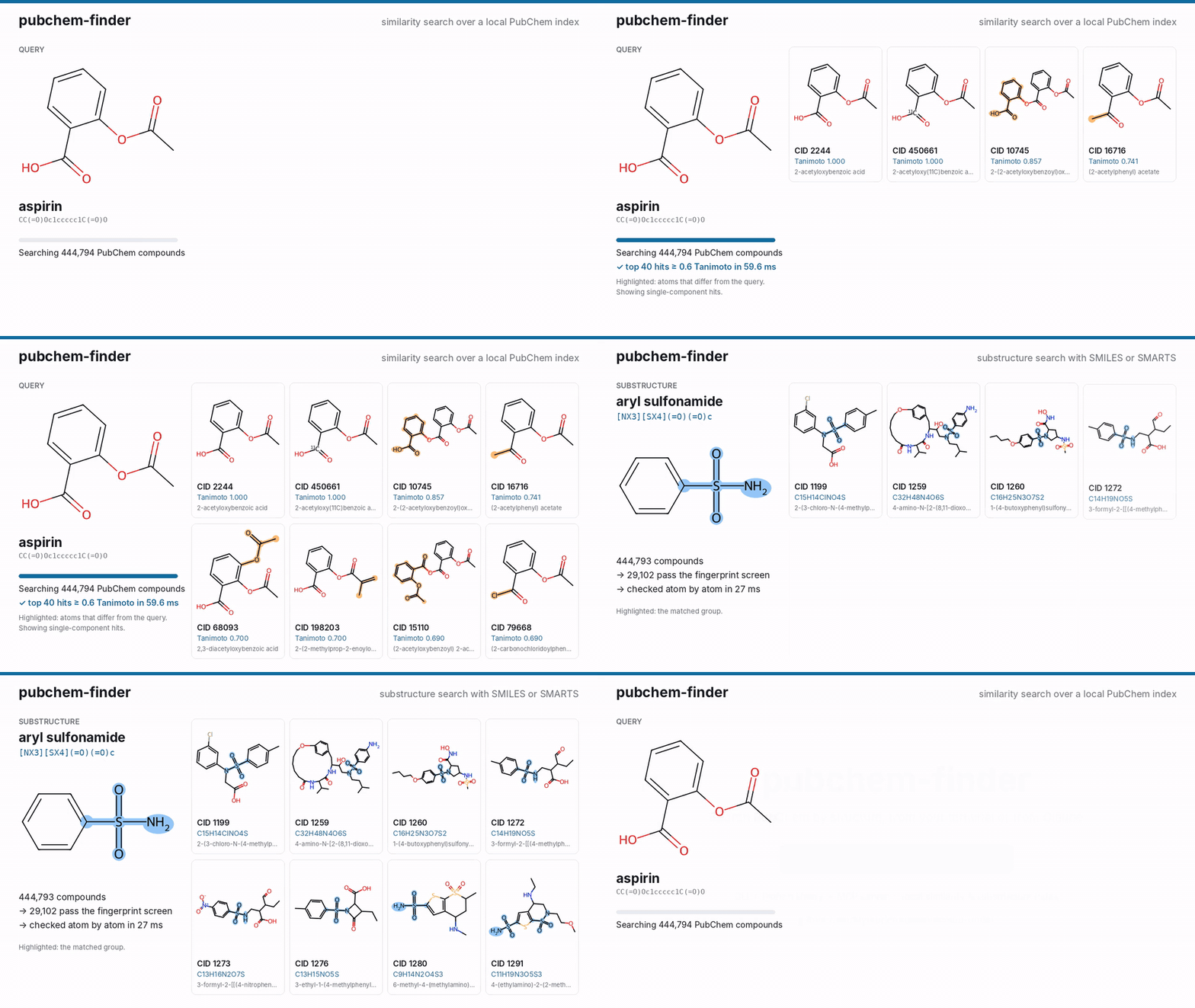
Real searches over the first 444,794 compounds of PubChem, rendered from the index the project's real-data workflow builds: similarity hits for aspirin with the atoms that differ from it highlighted, then hits for an aryl sulfonamide SMARTS with the match highlighted. MP4 version.
Why this one
Other PubChem tools, MCP servers and hosted connectors included, forward questions to PubChem's web API. That works for looking compounds up, but structure search through the API is rate-limited, times out on generic queries and returns unscored samples. PubChem Finder also keeps a local index:
- Exact, scored similarity search over every indexed compound (ECFP4 Tanimoto by default) in milliseconds, using FPSim2, the engine behind ChEMBL's similarity search.
- Local substructure search with SMILES or SMARTS: a fingerprint screen, then an atom-by-atom match, so every hit is a real match.
- Offline chemistry with RDKit: descriptors, standardization, PAINS/Brenk/NIH alerts, QED, synthetic accessibility, and drawings that show what changed between analogues.
- PubChem knowledge, cited: synonyms and CAS numbers, cross-references, GHS classification, pharmacology, toxicity and bioassay summaries, each with its source.
No database server, no Docker: the index is a pair of files in your data directory.
Use it from Claude
Requires uv, which fetches Python and everything else on first run.
Claude Code:
claude mcp add pubchem-finder -- uvx --python 3.14 pubchem-finder mcp
or as a plugin, which also works in Cowork:
/plugin install pubchem-finder --marketplace MysterionRise/pubchem-finder
Claude Desktop (Settings, Developer, Edit Config, then restart Claude):
{
  "mcpServers": {
    "pubchem-finder": {
      "command": "uvx",
      "args": ["--python", "3.14", "pubchem-finder", "mcp"]
    }
  }
}
Then ask things like:
- "What is the molecular weight and XLogP of caffeine? Is it Lipinski-compliant?"
- "Is ibuprofen hazardous? What does its GHS label say? Cite the sources."
- "What are the main targets of celecoxib in PubChem bioassays?"
- "Show me the closest analogues of aspirin and highlight what changed."
- "Does this compound have any PAINS alerts?
O=C1C(=Cc2ccccc2)SC(=S)N1" - "Find the 20 compounds most similar to ibuprofen" or "Which indexed compounds contain an aryl sulfonamide? Draw a few with the group highlighted." (local search: the demo set of FDA-approved drugs until you build an index)
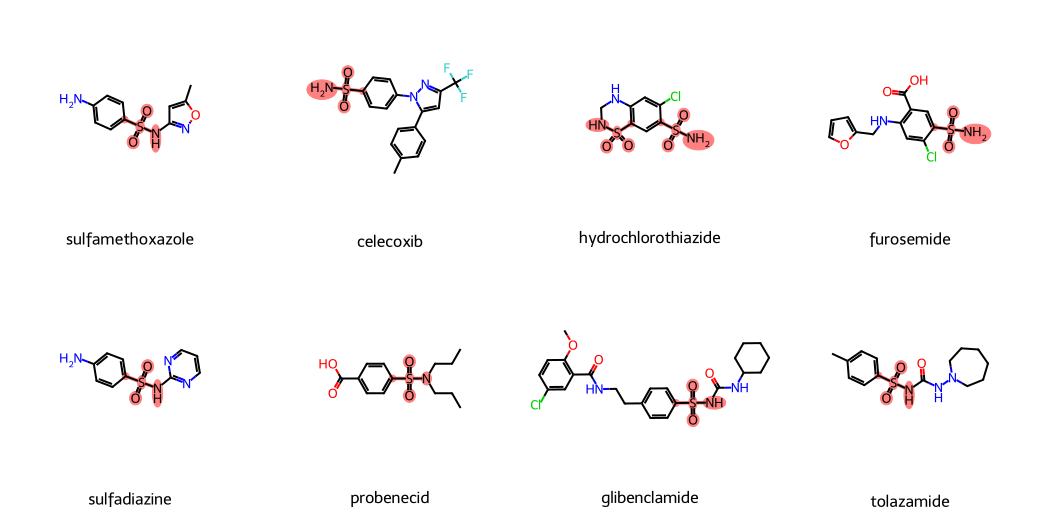
draw_molecules with highlight="smarts": eight sulfonamide drugs with the match for
[NX3][SX4](=O)(=O)c highlighted, as Claude shows it inline.
Local similarity and substructure search work from the first question: until you build
an index, they search a built-in demo set of 1,932 FDA-approved drugs (built in about a
second on first use) and say so. Build a PubChem index from the command line (below) and
the server switches to it, no restart needed. To use a non-default data directory, add
"env": {"PUBCHEM_FINDER_HOME": "/path"} to the Claude Desktop entry, or
--env PUBCHEM_FINDER_HOME=/path to claude mcp add.
Other MCP clients: the server speaks standard MCP over stdio, so any client that runs
local MCP servers (Cursor, VS Code, Windsurf, Zed, JetBrains IDEs, Codex CLI, LM Studio...)
can start it with the same command and arguments. It is listed in the
MCP registry as io.github.MysterionRise/pubchem-finder
for clients that install servers from there.
docs/clients.md
has the settings, a quick check, and setups people have tested; if you use one of those
clients, adding yours there is a good first contribution.
Over HTTP: pubchem-finder mcp --transport http serves the same tools at
http://127.0.0.1:8000/mcp (MCP streamable HTTP) for clients that connect to a URL
rather than start a process, and for one shared index on a team machine. For example,
claude mcp add --transport http pubchem-finder http://127.0.0.1:8000/mcp. The server has
no authentication or TLS of its own: read
Over HTTP
before binding it to anything but 127.0.0.1.
Tools
| Tool | What it does |
|---|---|
| pubchem_lookup(query, by, limit) | Resolve a name, CID, SMILES or InChIKey to PubChem records: identifiers, formula, MW, XLogP, H-bond counts, TPSA, link. |
| compound_properties(smiles) | RDKit descriptors and Lipinski check for any SMILES. Offline. |
| standardize(smiles) | Remove salts and counter-ions, neutralize, canonicalize; says what it removed. Offline. |
| compare(smiles_a, smiles_b) | Tanimoto similarity on ECFP4 and MACCS fingerprints. Offline. |
| medchem_profile(smiles) | QED, synthetic accessibility, Lipinski/Veber, PAINS/Brenk/NIH alerts with atoms, Murcko scaffold. Offline. |
| draw_molecules(smiles, legends, highlight, smarts, reference_smiles) | Structures as an inline image, highlighting a SMARTS match, what changed relative to a reference, or a similarity map. Offline. |
| similarity_search(smiles, threshold, top_k, metric, group_by_scaffold) | Most similar compounds in the local index (the demo set until one is built), optionally grouped by Murcko scaffold. |
| substructure_search(query, query_type, max_hits) | Indexed compounds containing a SMILES or SMARTS fragment, lowest CID first. |
| index_status() | Whether the local index is built, what it holds, what local searches cover now, and how to build what is missing. |
| pubchem_similarity_search(smiles, threshold, max_records) | Similar compounds across all of PubChem, live, re-scored with ECFP4. |
| pubchem_substructure_search(smiles, max_records) | Compounds across all of PubChem that contain a fragment, live. |
| pubchem_exact_match(smiles, identity_type) | The PubChem record(s) for exactly this structure, optionally ignoring stereo or isotopes. |
| pubchem_synonyms(cid, limit) | Common, brand and systematic names, plus CAS Registry Numbers. |
| pubchem_xrefs(cid) | Registry IDs (CAS, ChEMBL, DrugBank...), PubMed articles and patents. |
| pubchem_description(cid) | Curated descriptions, with sources. |
| pubchem_annotations(cid, heading, max_chars) | One section of the compound page: GHS classification, hazards, pharmacology, mechanism of action, drug information, experimental properties, toxicity, use, food additives. Every item names its source. |
| pubchem_bioactivity(cid) | Bioassay summary: assay count, outcomes, top targets (one per gene), lowest potency values (IC50, Ki...) among active results. |
Prompts and resources
Prompts start a whole workflow by name. In Claude Code they are slash commands, such as
/pubchem-finder:compound_dossier aspirin; each argument is one word (a SMILES works, and
a list is comma-separated without spaces).
| Prompt | What it does |
|---|---|
| compound_dossier(compound) | A cited profile of a compound (name, CID or SMILES): identity, structure, drug-likeness, GHS safety, pharmacology, bioassay targets. |
| find_analogues(compound, threshold) | Close analogues grouped by scaffold and drawn with what changed; also asks PubChem when only the demo set was searched. |
| triage_structures(structures) | Medicinal-chemistry triage of SMILES,SMILES,..., ranked, with the structural alerts drawn. |
Resources are data a client can attach to a conversation: pubchem://compound/{cid} (a
PubChem compound record as JSON; in Claude Code, @pubchem-finder:pubchem://compound/2244)
and pubchem://index/status.
Use it from the command line
uvx --python 3.14 pubchem-finder lookup caffeine                # PubChem record by name (--by cid, smiles or inchikey for those)
uvx --python 3.14 pubchem-finder props "CC(=O)Oc1ccccc1C(=O)O"  # RDKit descriptors (offline)
uvx runs the package without installing it; --python 3.14 keeps uv off Python 3.15
(see Troubleshooting). To install the command once:
uv tool install --python 3.14 pubchem-finder (or pip install pubchem-finder on Python
3.11 to 3.14). The examples below
assume it is installed. To try the development version, replace pubchem-finder with
--from git+https://github.com/MysterionRise/pubchem-finder pubchem-finder in any uvx
command.
Build a local index and search it
pubchem-finder index build --limit 1 --with-substructure   # first PubChem chunk: ~445,000 compounds
pubchem-finder search "CC(=O)Oc1ccccc1C(=O)O" --threshold 0.7 --top 20
pubchem-finder search "CC(=O)Oc1ccccc1C(=O)O" --group-by-scaffold
pubchem-finder substructure "c1ccc2[nH]ccc2c1"              # everything indexed that contains indole
pubchem-finder substructure "[NX3][SX4](=O)(=O)c" --smarts  # aryl sulfonamides, as SMARTS
pubchem-finder index status

pubchem-finder index build --sdf my_library.sdf.gz         # or index your own SDF files
Before any index is built, search and substructure use the built-in demo set: 1,932
FDA-approved drugs (PubChem's parent compounds of what it links to Drugs@FDA), built into
<data directory>/demo in about a second on first use, and the results say so
(search_scope: "demo" in JSON). index build --demo builds it ahead of time;
PUBCHEM_FINDER_DEMO=0 turns the fallback off. Once a PubChem or SDF index is built,
searches use it.
index build --limit N downloads the first N of PubChem's 359 SDF chunks (up to 500,000
CIDs each; the first is a 323 MB download) from NCBI over HTTPS, verifies each file's MD5,
fingerprints it, deletes the download and merges everything into one searchable index. Re-running is safe: finished
chunks are skipped, so an interrupted build resumes and a larger --limit extends an
existing index. --all indexes all of PubChem. The default fingerprint is ECFP4 (Morgan
radius 2, 1024 bits); --radius and --fp-size change it for a new index.
--sdf FILE (repeatable) indexes your own files, alongside PubCh
Truncated for display — read the full file on GitHub.
Related Skills
taste-skill
116.8kAgent skills that give coding agents taste: art direction, reference images and a browser check instead of generic AI pages
Agent-Reach
112.3kGive your AI agent eyes to see the entire internet. Read & search Twitter, Reddit, YouTube, GitHub, Bilibili, XiaoHongShu — one CLI, zero API fees.
ruflo
81.9k🌊 The original agent harness. Deploy intelligent multi-player swarms, coordinate autonomous workflows, and build conversational AI systems. Features adaptive memory, self-learning intelligence, federation, vector RAG integration, and native Claude Code / Codex / Hermes and many more Integrated
headroom
79.8kCompress tool outputs, logs, files, and RAG chunks before they reach the LLM. 20% fewer tokens for coding agents, 60-95% fewer tokens for JSON, same answers. Library, proxy, MCP server.

Languages
Trust signals
From repository metadata: license, adoption, age and documentation. Not a code audit — see the Safety scan above for what the skill file itself contains.