
MolScore
An automated scoring function to facilitate and standardize the evaluation of goal-directed generative models for de novo molecular design
Install / Use
/learn @MorganCThomas/MolScoreREADME
MolScore: A scoring, evaluation and benchmarking framework for de novo drug design





Overview
Paper | Tutorials | Examples | Demo
MolScore contains code to score de novo compounds in the context of generative de novo design by generative models via the subpackage molscore, as well as, facilitate downstream evaluation via the subpackage moleval. An objective is defined via a JSON file which can be shared to propose new multi-parameter objectives for drug design. MolScore can be used in several ways:
- To implement a multi-parameter objective to for prospective drug design.
- To benchmark objectives/generative models/optimization using benchmark mode (MolScoreBenchmark).
- To implement a sequence of objectives using curriculum mode (MolScoreCurriculum).
Contributions and/or ideas for added functionality are welcomed!
Installation
Install MolScore with PyPI (recommended):
pip install molscore --upgrade
or directly from GitHub:
git clone https://github.com/MorganCThomas/MolScore.git
cd MolScore ; pip install -e .
Note: I recommend mamba for environment handling
Scoring
Simplest integration of MolScore requires a config file, for example:
from molscore import MolScore
ms = MolScore(
    model_name='test',
    task_config='molscore/configs/QED.json',
    budget=10000
)
with ms as scoring_function:
    while not scoring_function.finished:
        scores = scoring_function.score(SMILES)
Note: see tutorial for more detail
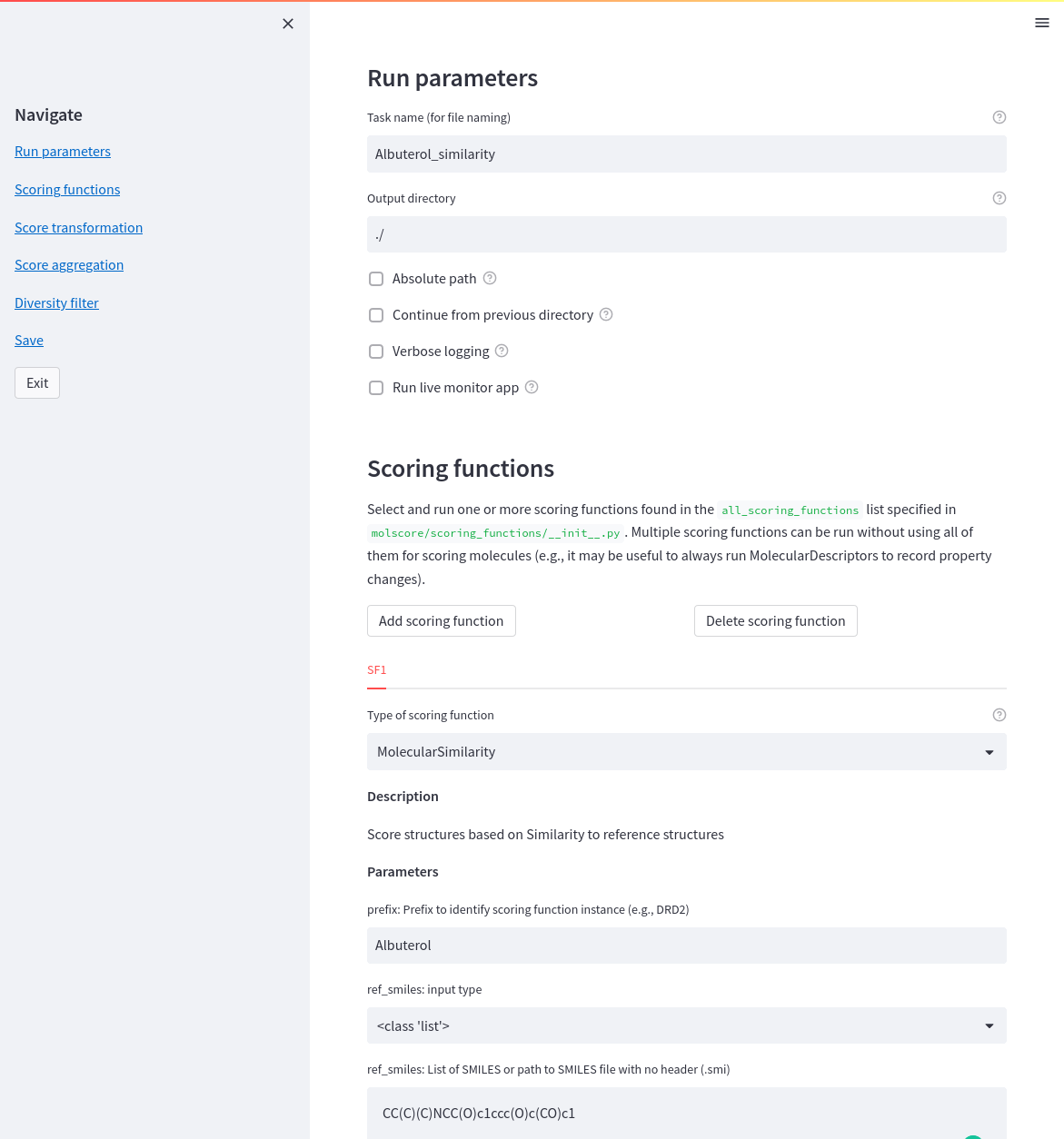
A GUI exists to help write the config file, which can be run with the following command.
molscore_config
Note: see tutorial for more detail
Scoring functions
- Descriptors: RDKit, Maximum consecutive rotatable bonds, Penalized LogP, LinkerDescriptors (Fragment linking),
- MolSkill: Extracting medicinal chemistry intuition via preference machine learning as available on Nature Communications.
- Synthesizability: RAscore, AiZynthFinder, SAscore, ReactionFilters (Scaffold decoration)
- 2D Similarity: Fingerprint similarity (any RDKit fingerprint and similarity measure), substructure match/filter, Applicability domain
- 3D Similarity: ROCS, Open3DAlign
- QSAR: Scikit-learn (classification/regression), ChemProp
- Docking: Glide<sup>a</sup>, Smina, OpenEye<sup>a</sup>, GOLD<sup>a</sup>, PLANTS, rDock, Vina, Gnina
- Ligand preparation: RDKit->Epik, Moka->Corina, Ligprep, Gypsum-DL
<sup>a</sup> Requires a license
Transformation functions (transform values to [0-1])
- Linear
- Linear threshold
- Step
- Step threshold
- Gaussian
Aggregation functions (combine multiple scores into 1)
- Arithmetic mean
- Geometric mean
- Weighted sum
- Weighted product
- Auto-weighted sum/product
- Pareto front
Filters (applied to final aggregated score)
- Any scoring function as a filter
- Diversity filters
Benchmarking
Benchmarks are lists of objectives (configuration files) with metrics calculated upon exit. Re-implementations of existing benchmarks are available as presets.
from molscore import MolScoreBenchmark

msb = MolScoreBenchmark(
    model_name='test',
    output_dir='./',
    benchmark='GuacaMol',
    budget=10000
)
with msb as benchmark:
    for task in msb:
        with task as scoring_function:
            while not scoring_function.finished:
                scores = scoring_function.score(SMILES)
Current benchmarks available include: GuacaMol, GuacaMol_Scaffold, MolOpt, 5HT2A_PhysChem, 5HT2A_Selectivity, '5HT2A_Docking', LibINVENT Exp1&3, MolExp(L)
Note: inspect preset benchmarks with
MolScoreBenchmark.presets.keys()
Note: see tutorial for more detail
Evaluation
The moleval subpackage can be used to calculate metrics for an arbitrary set of molecules.
from moleval.metrics.metrics import GetMetrics

MetricEngine = GetMetrics(
    test=TEST_SMILES, # Model training data subset
    train=TRAIN_SMILES, # Model training data
    target=TARGET_SMILES, # Exemplary target data
)
metrics = MetricEngine.calculate(
    GEN_SMILES, # Generated data
)
<details> <summary><strong>Metrics available</strong></summary> <!-- This adds a non-breaking space for some spacing -->Note: see tutorial for more detail
Intrinsice metrics (generated molecules only)
- Validity, Uniqueness, Scaffold uniqueness, Internal diversity (1 & 2), Scaffold diversity
- Sphere exclusion diversity: Measure of chemical space coverage at a specific Tanimoto similarity threshold. I.e., A score 0.5 indicates 50% of the sample size sufficiently describes the chemical space, therefore the higher the metric the more diverse the sample. Also see here
- Solow Polasky diversity
- Functional group diversity
- Ring system diversity
- Filters: Passing of a set of drug-like filters (MolWt, Rotatable bonds, LogP etc.), Medicinal Chemistry substructures and PAINS substructures.
- Purchasability: Molbloom prediction of presence in ZINC20
Extrinsic metrics (comparison to reference molecules)
- Novelty
- FCD
- Analogue similarity: Proportion of generated molecules that are analogues to molecules in reference data.
- Analogue coverage: Proportion of reference data that are analogues to generated data.
- Functional group similarity
- Ring system similarity
- Single nearest neighbour similarity
- Fragment similarity
- Scaffold similarity
- Outlier bits (Silliness): Average proportion of fingerprint bits (atomic environments) present in a generated molecule, not present anywhere in the reference data. The lower the silliness the better.
- Wasserstein distance (LogP, SA Score, NP score, QED, Weight)
Additional functionality
-
Curriculum learning (see tutorial)
-
Experience replay buffers (see tutorial)
-
Parallelisation (see tutorial)
-
A GUI for monitoring generated molecules (see below)
molscore_monitor

Citation & Publications
If you use this software, please cite it as below.
@article{thomas2024molscore,
title={MolScore: a scoring, evaluation and benchmarking framework for generative models in de novo drug design},
author={Thomas, Morgan and O’Boyle, Noel M and Bender, Andreas and De Graaf, Chris},
journal={Journal of Cheminformatics},
volume={16},
year={2024},
publisher={BMC}
}
This software was also utilised in the following publi
Related Skills
openpencil
2.1kThe world's first open-source AI-native vector design tool and the first to feature concurrent Agent Teams. Design-as-Code. Turn prompts into UI directly on the live canvas. A modern alternative to Pencil.
ui-ux-pro-max-skill
61.3kAn AI SKILL that provide design intelligence for building professional UI/UX multiple platforms
ui-ux-pro-max-skill
61.3kAn AI SKILL that provide design intelligence for building professional UI/UX multiple platforms
onlook
25.1kThe Cursor for Designers • An Open-Source AI-First Design tool • Visually build, style, and edit your React App with AI

