
Shrinkbench
PyTorch library to facilitate development and standardized evaluation of neural network pruning methods.
Install / Use
/learn @JJGO/ShrinkbenchREADME
ShrinkBench
Open source PyTorch library to facilitate development and standardized evaluation of neural network pruning methods.
Paper
This repo contains the analysis and benchmarks results from the paper What is the State of Neural Network Pruning?.
Installation
First, install the dependencies, this repo depends on
PyTorchTorchvisionNumPyPandasMatplotlib
To install the dependencies
# Create a python virtualenv or conda env as necessary

# With conda
conda install numpy matplotlib pandas tqdm
conda install pytorch torchvision -c pytorch

# With pip
pip install numpy matplotlib pandas torch torchvision tqdm
then, to install the module itself you just need to clone the repo and add the parent path it to your PYTHONPATH. For example:
git clone git@github.com:JJGO/shrinkbench.git shrinkbench

# Bash
echo "export PYTHONPATH=\"$PWD:\$PYTHONPATH\"" >> ~/.bashrc

# ZSH
echo "export PYTHONPATH=\"$PWD:\$PYTHONPATH\"" >> ~/.zshrc
Strategies
ShrinkBench not only faciliates evaluation of pruning methods, but also their development. Here's the code for a simple implementation of Global Magnitude Pruning and Layerwise Magnitude Pruning. As you can see, it is quite succint; you are just tasked with implementing model_masks a function that returns the masks for the model's weight tensors. If you want to prune your model layerwise, then you just need to implement layer_masks. For more examples, see the source code for the provided baselines.
class GlobalMagWeight(VisionPruning):

    def model_masks(self):
        importances = map_importances(np.abs, self.params())
        flat_importances = flatten_importances(importances)
        threshold = fraction_threshold(flat_importances, self.fraction)
        masks = importance_masks(importances, threshold)
        return masks


class LayerMagWeight(LayerPruning, VisionPruning):

    def layer_masks(self, module):
        params = self.module_params(module)
        importances = {param: np.abs(value) for param, value in params.items()}
        masks = {param: fraction_mask(importances[param], self.fraction)
                 for param, value in params.items() if value is not None}
        return masks
Experiments
See here for a notebook showing how to run pruning experiments and plot their results
Modules
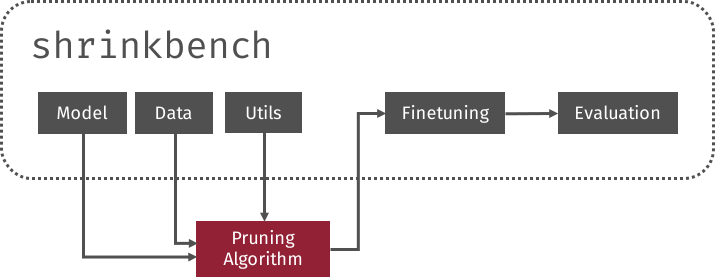
The modules are organized as follows:
| submodule | Description |
| ---- | ---- |
| analysis/ | Aggregated survey results over 80 pruning papers |
| datasets/ | Standardized dataloaders for supported datasets |
| experiment/ | Main experiment class with the data loading, pruning, finetuning & evaluation |
| metrics/ | Utils for measuring accuracy, model size, flops & memory footprint |
| models/ | Custom architectures not included in torchvision |
| plot/ | Utils for plotting across the logged dimensions |
| pruning/ | General pruning and masking API. |
| scripts/ | Executable scripts for running experiments (see experiment/) |
| strategies/ | Baselines pruning methods, mainly magnitude pruning based |
Related Skills
node-connect
349.2kDiagnose OpenClaw node connection and pairing failures for Android, iOS, and macOS companion apps
frontend-design
109.5kCreate distinctive, production-grade frontend interfaces with high design quality. Use this skill when the user asks to build web components, pages, or applications. Generates creative, polished code that avoids generic AI aesthetics.
openai-whisper-api
349.2kTranscribe audio via OpenAI Audio Transcriptions API (Whisper).
qqbot-media
349.2kQQBot 富媒体收发能力。使用 <qqmedia> 标签,系统根据文件扩展名自动识别类型(图片/语音/视频/文件)。
