
Cmaes
Python library for CMA Evolution Strategy.
Install / Use
/learn @CyberAgentAILab/CmaesREADME
cmaes


:whale: Paper is now available on arXiv!
Simple and Practical Python library for CMA-ES. Please refer to the paper [Nomura et al. 2026] for detailed information, including the design philosophy and advanced examples.
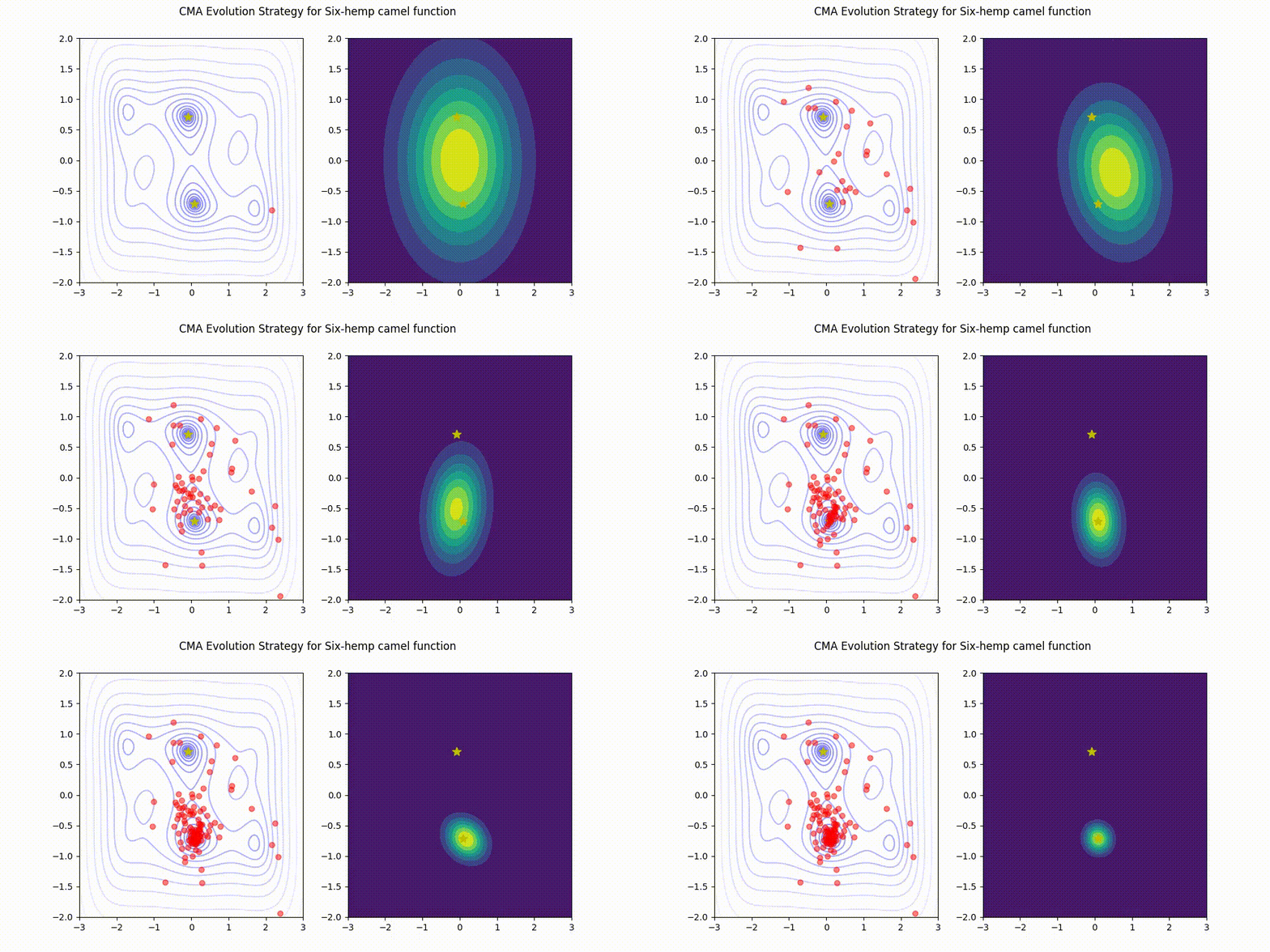
Installation
Supported Python versions are 3.8 or later.
$ pip install cmaes
Or you can install via conda-forge.
$ conda install -c conda-forge cmaes
Usage
This library provides an "ask-and-tell" style interface. We employ the standard version of CMA-ES [Hansen 2016].
import numpy as np
from cmaes import CMA

def quadratic(x1, x2):
    return (x1 - 3) ** 2 + (10 * (x2 + 2)) ** 2

if __name__ == "__main__":
    optimizer = CMA(mean=np.zeros(2), sigma=1.3)

    for generation in range(50):
        solutions = []
        for _ in range(optimizer.population_size):
            x = optimizer.ask()
            value = quadratic(x[0], x[1])
            solutions.append((x, value))
            print(f"#{generation} {value} (x1={x[0]}, x2 = {x[1]})")
        optimizer.tell(solutions)
You can also use this library via Optuna [Akiba et al. 2019], an automatic hyperparameter optimization framework.
import optuna

def objective(trial: optuna.Trial):
    x1 = trial.suggest_float("x1", -4, 4)
    x2 = trial.suggest_float("x2", -4, 4)
    return (x1 - 3) ** 2 + (10 * (x2 + 2)) ** 2

if __name__ == "__main__":
    sampler = optuna.samplers.CmaEsSampler()
    study = optuna.create_study(sampler=sampler)
    study.optimize(objective, n_trials=250)
For more information, see the documentation.
CMA-ES variants
CatCMA with Margin [Hamano et al. 2025]
CatCMA with Margin (CatCMAwM) is a method for mixed-variable optimization problems, simultaneously optimizing continuous, integer, and categorical variables. CatCMAwM extends CatCMA by introducing a novel integer handling mechanism, and supports arbitrary combinations of continuous, integer, and categorical variables in a unified framework.
import numpy as np
from cmaes import CatCMAwM


def SphereIntCOM(x, z, c):
    return sum(x * x) + sum(z * z) + len(c) - sum(c[:, 0])


def SphereInt(x, z):
    return sum(x * x) + sum(z * z)


def SphereCOM(x, c):
    return sum(x * x) + len(c) - sum(c[:, 0])


def f_cont_int_cat():
    # [lower_bound, upper_bound] for each continuous variable
    X = [[-5, 5], [-5, 5]]
    # possible values for each integer variable
    Z = [[-1, 0, 1], [-2, -1, 0, 1, 2]]
    # number of categories for each categorical variable
    C = [3, 3]

    optimizer = CatCMAwM(x_space=X, z_space=Z, c_space=C)

    for generation in range(50):
        solutions = []
        for _ in range(optimizer.population_size):
            sol = optimizer.ask()
            value = SphereIntCOM(sol.x, sol.z, sol.c)
            solutions.append((sol, value))
            print(f"#{generation} {sol} evaluation: {value}")
        optimizer.tell(solutions)


def f_cont_int():
    # [lower_bound, upper_bound] for each continuous variable
    X = [[-np.inf, np.inf], [-np.inf, np.inf]]
    # possible values for each integer variable
    Z = [[-2, -1, 0, 1, 2], [-2, -1, 0, 1, 2]]

    # initial distribution parameters (Optional)
    # If you know a promising solution for X and Z, set init_mean to that value.
    init_mean = np.ones(len(X) + len(Z))
    init_cov = np.diag(np.ones(len(X) + len(Z)))
    init_sigma = 1.0

    optimizer = CatCMAwM(
        x_space=X, z_space=Z, mean=init_mean, cov=init_cov, sigma=init_sigma
    )

    for generation in range(50):
        solutions = []
        for _ in range(optimizer.population_size):
            sol = optimizer.ask()
            value = SphereInt(sol.x, sol.z)
            solutions.append((sol, value))
            print(f"#{generation} {sol} evaluation: {value}")
        optimizer.tell(solutions)


def f_cont_cat():
    # [lower_bound, upper_bound] for each continuous variable
    X = [[-5, 5], [-5, 5]]
    # number of categories for each categorical variable
    C = [3, 5]

    # initial distribution parameters (Optional)
    init_cat_param = np.array(
        [
            [0.5, 0.3, 0.2, 0.0, 0.0],  # zero-padded at the end
            [0.2, 0.2, 0.2, 0.2, 0.2],  # each row must sum to 1
        ]
    )

    optimizer = CatCMAwM(x_space=X, c_space=C, cat_param=init_cat_param)

    for generation in range(50):
        solutions = []
        for _ in range(optimizer.population_size):
            sol = optimizer.ask()
            value = SphereCOM(sol.x, sol.c)
            solutions.append((sol, value))
            print(f"#{generation} {sol} evaluation: {value}")
        optimizer.tell(solutions)


if __name__ == "__main__":
    f_cont_int_cat()
    # f_cont_int()
    # f_cont_cat()
The full source code is available here.
</details>We recommend using CatCMAwM for continuous+integer and continuous+categorical settings. In particular, [Hamano et al. 2025] shows that CatCMAwM outperforms CMA-ES with Margin in mixed-integer scenarios. Therefore, we suggest CatCMAwM in place of CMA-ES with Margin or CatCMA.
COMO-CatCMA with Margin [Hamano et al. 2026]
COMO-CatCMA with Margin (COMO-CatCMAwM) performs multi-objective mixed-variable optimization by coordinating multiple CatCMAwM optimizers. It currently supports two-objective problems; support for three or more objectives is planned.
<details> <summary>Source code</summary>import numpy as np
from cmaes import COMOCatCMAwM
def DSIntLFTL(x, z, c, cat_num):
Sphere1 = sum((x / 10) ** 2) / len(x)
Sphere2 = sum((x / 10 - 1) ** 2) / len(x)
SphereInt1 = sum((z / 10) ** 2) / len(z)
SphereInt2 = sum((z / 10 - 1) ** 2) / len(z)
c_idx = c.argmax(axis=1)
LF = (len(c) - (c_idx == 0).cumprod().sum()) / len(c)
TL = (len(c) - (c_idx == np.asarray(cat_num) - 1)[::-1].cumprod().sum()) / len(c)
obj1 = Sphere1 + SphereInt1 + LF
obj2 = Sphere2 + SphereInt2 + TL
return [obj1, obj2]
if __name__ == "__main__":
# [lower_bound, upper_bound] for each continuous variable
X = [[-5, 15]] * 3
# possible values for each integer variable
Z = [range(-5, 16)] * 3
# number of categories for each categorical variable
C = [5] * 3
optimizer = COMOCatCMAwM(x_space=X, z_space=Z, c_space=C)
evals = 0
while evals < 7000:
solutions = []
for sol in optimizer.ask_iter():
value = DSIntLFTL(sol.x, sol.z, sol.c, C)
evals += 1
solutions.append((sol, value))
optimizer.tell(solutions)
print(evals, optimizer.incumbent_objectives)
The full source code is available here.
</details>CatCMA [Hamano et al. 2024a]
CatCMA is a method for mixed-category optimization problems, which is the problem of simultaneously optimizing continuous and categorical variables. CatCMA employs the joint probability distribution of multivariate Gaussian and categorical distributions as the search distribution.
import numpy as np
from cmaes import CatCMA


def sphere_com(x, c):
    dim_co = len(x)
    dim_ca = len(c)
    if dim_co < 2:
        raise ValueError("dimension must be greater one")
    sphere = sum(x * x)
    com = dim_ca - sum(c[:, 0])
    return sphere + com


def rosenbrock_clo(x, c):
    dim_co = len(x)
    dim_ca = len(c)
    if dim_co < 2:
        raise ValueError("dimension must be greater one")
    rosenbrock = sum(100 * (x[:-1] ** 2 - x[1:]) ** 2 + (x[:-1] - 1) ** 2)
    clo = dim_ca - (c[:, 0].argmin() + c[:, 0].prod() * dim_ca)
    return rosenbrock + clo


def mc_proximity(x, c, cat_num):
    dim_co = len(x)
    dim_ca = len(c)
    if dim_co < 2:
        raise ValueError("dimension must be greater one")
    if dim_co != dim_ca:
        raise ValueError(
            "number of dimensions of continuous and categorical variables "
            "must be equal in mc_proximity"
        )

    c_index = np.argmax(c, axis=1) / cat_num
    return sum((x - c_index) ** 2) + sum(c_index)


if __name__ == "__main__":
    cont_dim = 5
    cat_dim = 5
    cat_num = np.array([3, 4, 5, 5, 5])
    # cat_num = 3 * np.ones(cat_dim, dtype=np.int64)
    optimizer = CatCMA(mean=3.0 * np.ones(cont_dim), sigma=1.0, cat_num=cat_num)

    for generation in range(200):
        solutions = []
        for _ in range(optimizer.population_size):
            x, c = optimizer.ask()
            value = mc_proximity(x, c, cat_num)
            if generation % 10 == 0:
                print(f"#{generation} {value}")
            solutions.append(((x, c), value))
        optimizer.tell(solutions)

        if optimizer.should_stop():
            break
The full source code is available here.
</details>Safe CMA [Uchida et al. 2024a]
Safe CMA-ES is a variant of CMA-ES for safe optimization. Safe optimization is formulated as a special type of constrained optimization problem aiming to solve the optimization problem with fewer evaluations of the solutions whose safety function values exceed the safety thresholds. The safe CMA-E
