
Lppls
Library for fitting the LPPLS model to data.
Install / Use
/learn @Boulder-Investment-Technologies/LpplsREADME


Log Periodic Power Law Singularity (LPPLS) Model
lppls is a Python module for fitting the LPPLS model to data.
Overview
The LPPLS model provides a flexible framework to detect bubbles and predict regime changes of a financial asset. A bubble is defined as a faster-than-exponential increase in asset price, that reflects positive feedback loop of higher return anticipations competing with negative feedback spirals of crash expectations. It models a bubble price as a power law with a finite-time singularity decorated by oscillations with a frequency increasing with time.
Try the demo:

Here is the model:
E[ln\ p(t)] = A + B(t_c-t)^{m}+C(t_c-t)^{m}\cos(\omega\ ln(t_c-t) - \phi)
where:
- $E[ln\ p(t)]$: expected log price at the date of the termination of the bubble
- $t_c$: critical time (date of termination of the bubble and transition in a new regime)
- $A$: expected log price at the peak when the end of the bubble is reached at $t_c$
- $B$: amplitude of the power law acceleration
- $C$: amplitude of the log-periodic oscillations
- $m$: degree of the super exponential growth
- $\omega$: scaling ratio of the temporal hierarchy of oscillations
- $\phi$: time scale of the oscillations
The model has three components representing a bubble. The first, $A+B(t_c-t)^{m}$, handles the hyperbolic power law. For $m$ < 1 when the price growth becomes unsustainable, and at $t_c$ the growth rate becomes infinite. The second term, $C(t_c-t)^{m}$, controls the amplitude of the oscillations. It drops to zero at the critical time $t_c$. The third term, $\cos(\omega\ ln(t_c-t) - \phi)$, models the frequency of the oscillations. They become infinite at $t_c$.
Important links
- Official source code repo: https://github.com/Boulder-Investment-Technologies/lppls
- Download releases: https://pypi.org/project/lppls/
- Issue tracker: https://github.com/Boulder-Investment-Technologies/lppls/issues
Installation
Dependencies
lppls requires:
- Python (>= 3.10)
- CMA-ES (>= 3.3.0)
- Matplotlib (>= 3.5.0)
- Numba (>= 0.56.0)
- NumPy (>= 1.23.0)
- Pandas (>= 1.5.0)
- SciPy (>= 1.9.0)
- Scikit-learn (>= 1.2.0)
- tqdm (>= 4.64.0)
- Xarray (>= 2024.1.0)
User installation
pip install -U lppls
Example Use
from lppls import lppls, data_loader
import numpy as np
import pandas as pd
from datetime import datetime as dt
%matplotlib inline

# read example dataset into df
data = data_loader.nasdaq_dotcom()

# convert time to ordinal
time = [pd.Timestamp.toordinal(dt.strptime(t1, '%Y-%m-%d')) for t1 in data['Date']]

# create list of observation data
price = np.log(data['Adj Close'].values)

# create observations array (expected format for LPPLS observations)
observations = np.array([time, price])

# set the max number for searches to perform before giving-up
# the literature suggests 25
MAX_SEARCHES = 25

# instantiate a new LPPLS model with the Nasdaq Dot-com bubble dataset
lppls_model = lppls.LPPLS(observations=observations)

# fit the model to the data and get back the params
tc, m, w, a, b, c, c1, c2, O, D = lppls_model.fit(MAX_SEARCHES)

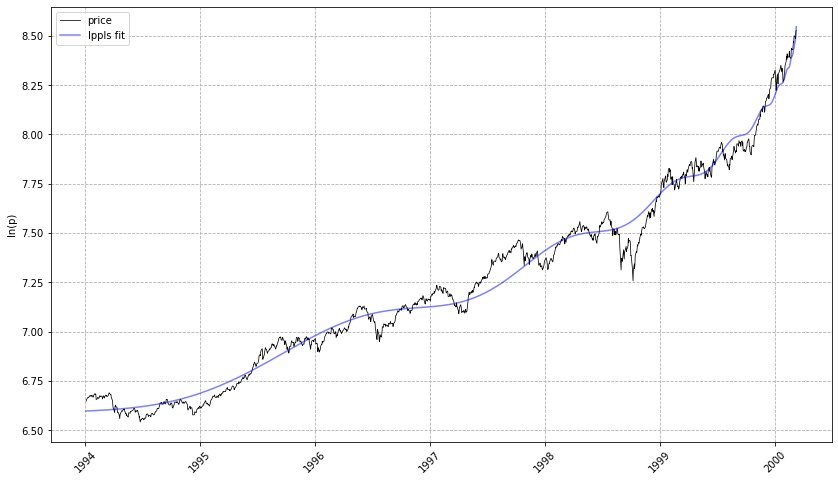
# visualize the fit
lppls_model.plot_fit()

# should give a plot like the following...
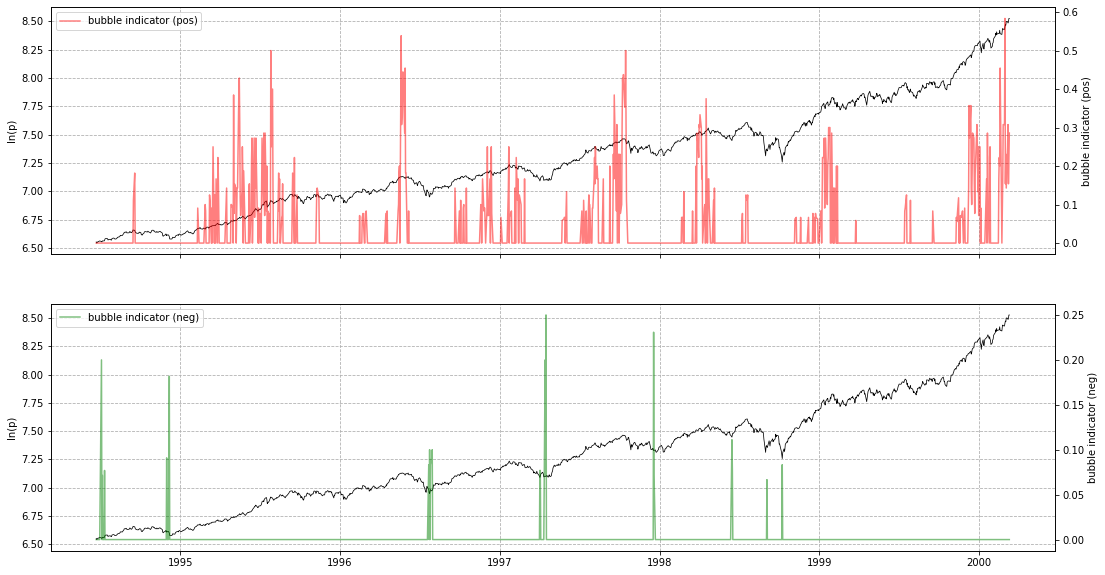
# compute the confidence indicator
res = lppls_model.mp_compute_nested_fits(
    workers=8,
    window_size=120,
    smallest_window_size=30,
    outer_increment=1,
    inner_increment=5,
    max_searches=25,
    # filter_conditions_config={} # not implemented in 0.6.x
)

lppls_model.plot_confidence_indicators(res)
# should give a plot like the following...
If you wish to store res as a pd.DataFrame, use compute_indicators.
res_df = lppls_model.compute_indicators(res)
res_df
# gives the following...
Quantile Regression
Based on the work in Zhang, Zhang & Sornette 2016, quantile regression for LPPLS uses the L1 norm (sum of absolute differences) instead of the L2 norm and applies the q-dependent loss function during calibration. Please refer to the example usage here.
Lagrange Regularization for Bubble Start Time Detection
The lppls library includes a method for determining the start time of a financial bubble using Lagrange regularization. This technique, inspired by the work of Demos & Sornette (2017), addresses the challenge of model overfitting when the bubble's inception is unknown.
By introducing a regularization term to the normalized sum of squared residuals, the method objectively identifies the optimal fitting window size. This allows for a more robust and data-driven estimation of the bubble's start time without requiring exogenous information, which is a significant improvement over previous approaches.
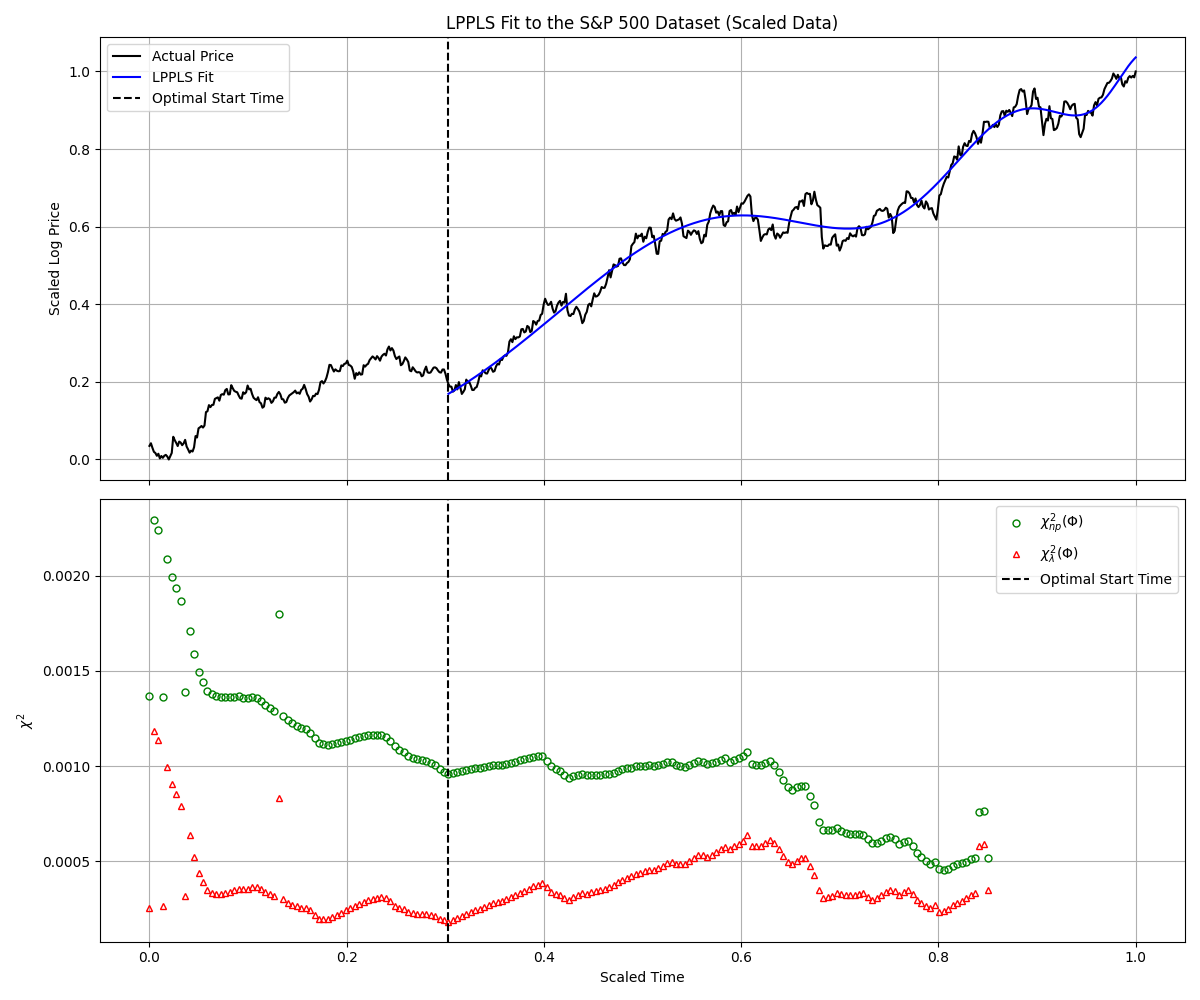
This functionality is available through the detect_bubble_start_time_via_lagrange method. For detailed usage, please refer to the tutorial here.
Other Search Algorithms
Shu and Zhu (2019) proposed CMA-ES for identifying the best estimation of the three non-linear parameters ($t_c$, $m$, $\omega$).
The CMA-ES rates among the most successful evolutionary algorithms for real-valued single-objective optimization and is typically applied to difficult nonlinear non-convex black-box optimization problems in continuous domain and search space dimensions between three and a hundred. Parallel computing is adopted to expedite the fitting process drastically.
This approach has been implemented in a subclass and can be used as follows... Thanks to @paulogonc for the code.
from lppls import lppls_cmaes
lppls_model = lppls_cmaes.LPPLSCMAES(observations=observations)
tc, m, w, a, b, c, c1, c2, O, D = lppls_model.fit(max_iteration=2500, pop_size=4)
Performance Note: this works well for single fits but can take a long time for computing the confidence indicators. More work needs to be done to speed it up.
References
- Filimonov, V. and Sornette, D. A Stable and Robust Calibration Scheme of the Log-Periodic Power Law Model. Physica A: Statistical Mechanics and its Applications. 2013
- Shu, M. and Zhu, W. Real-time Prediction of Bitcoin Bubble Crashes. 2019.
- Sornette, D. Why Stock Markets Crash: Critical Events in Complex Financial Systems. Princeton University Press. 2002.
- Sornette, D. and Demos, G. and Zhang, Q. and Cauwels, P. and Filimonov, V. and Zhang, Q., Real-Time Prediction and Post-Mortem Analysis of the Shanghai 2015 Stock Market Bubble and Crash (August 6, 2015). Swiss Finance Institute Research Paper No. 15-31.
- Demos, G. and Sornette, D. Lagrange regularisation approach to compare nested data sets and determine objectively financial bubbles' inceptions. 2017. arXiv:1707.07162
- Zhang, Q., Zhang, Q., and Sornette, D. Early Warning Signals of Financial Crises with Multi-Scale Quantile Regressions of Log-Periodic Power Law Singularities. PLOS ONE. 2016. DOI:10.1371/journal.pone.0165819
Related Skills
claude-opus-4-5-migration
82.2kMigrate prompts and code from Claude Sonnet 4.0, Sonnet 4.5, or Opus 4.1 to Opus 4.5
model-usage
334.5kUse CodexBar CLI local cost usage to summarize per-model usage for Codex or Claude, including the current (most recent) model or a full model breakdown. Trigger when asked for model-level usage/cost data from codexbar, or when you need a scriptable per-model summary from codexbar cost JSON.
TrendRadar
49.7k⭐AI-driven public opinion & trend monitor with multi-platform aggregation, RSS, and smart alerts.🎯 告别信息过载,你的 AI 舆情监控助手与热点筛选工具!聚合多平台热点 + RSS 订阅,支持关键词精准筛选。AI 智能筛选新闻 + AI 翻译 + AI 分析简报直推手机,也支持接入 MCP 架构,赋能 AI 自然语言对话分析、情感洞察与趋势预测等。支持 Docker ,数据本地/云端自持。集成微信/飞书/钉钉/Telegram/邮件/ntfy/bark/slack 等渠道智能推送。
mcp-for-beginners
15.6kThis open-source curriculum introduces the fundamentals of Model Context Protocol (MCP) through real-world, cross-language examples in .NET, Java, TypeScript, JavaScript, Rust and Python. Designed for developers, it focuses on practical techniques for building modular, scalable, and secure AI workflows from session setup to service orchestration.
