
EventualShop
A state-of-the-art distributed system using Reactive DDD as uncertainty modeling, Event Storming as subdomain decomposition, Event Sourcing as an eventual persistence mechanism, CQRS, Async Projections, Microservices for individual deployable units, Event-driven Architecture for efficient integration, and Clean Architecture as domain-centric design
Install / Use
/learn @AntonioFalcaoJr/EventualShopREADME

| Service | Command Stack | Query Stack |
|---------------|:----------------------------------------------------------------------------------------------------------------------------------------------------------------------------------------------------------------------------------------:|:----------------------------------------------------------------------------------------------------------------------------------------------------------------------------------------------------------------------------------:|
| Account |  |
|  |
| Communication |
|
| Communication |  |
|  |
| Identity |
|
| Identity |  |
|  |
| Order |
|
| Order |  |
|  |
| Catalog |
|
| Catalog |  |
|  |
| Warehouse |
|
| Warehouse |  |
|  |
| Shopping Cart |
|
| Shopping Cart |  |
|  |
| Payment |
|
| Payment |  |
|  |
|
:construction: <sub>Work in Progress (WIP)</sub>
</div>:bulb: About
The main objective of this cloud-native project is to represent the state-of-the-art of a distributed, reliable, and highly scalable system by interpreting the most relevant principles of Reactive Domain Driven Design.
Domain-Driven Design can aid with managing uncertainty through the use of good modeling.
-- Vaughn Vernon
Scalability and Resilience require low coupling and high cohesion, principles strongly linked to the proper understanding of the business through well-defined boundaries, combined with a healthy and efficient integration strategy such as Event-driven Architecture (EDA).
The Event Storming workshop provides a practical approach to subdomain decomposition, using Pivotal Events to correlate business capabilities across Bounded Contexts while promoting reactive integration between Aggregates.
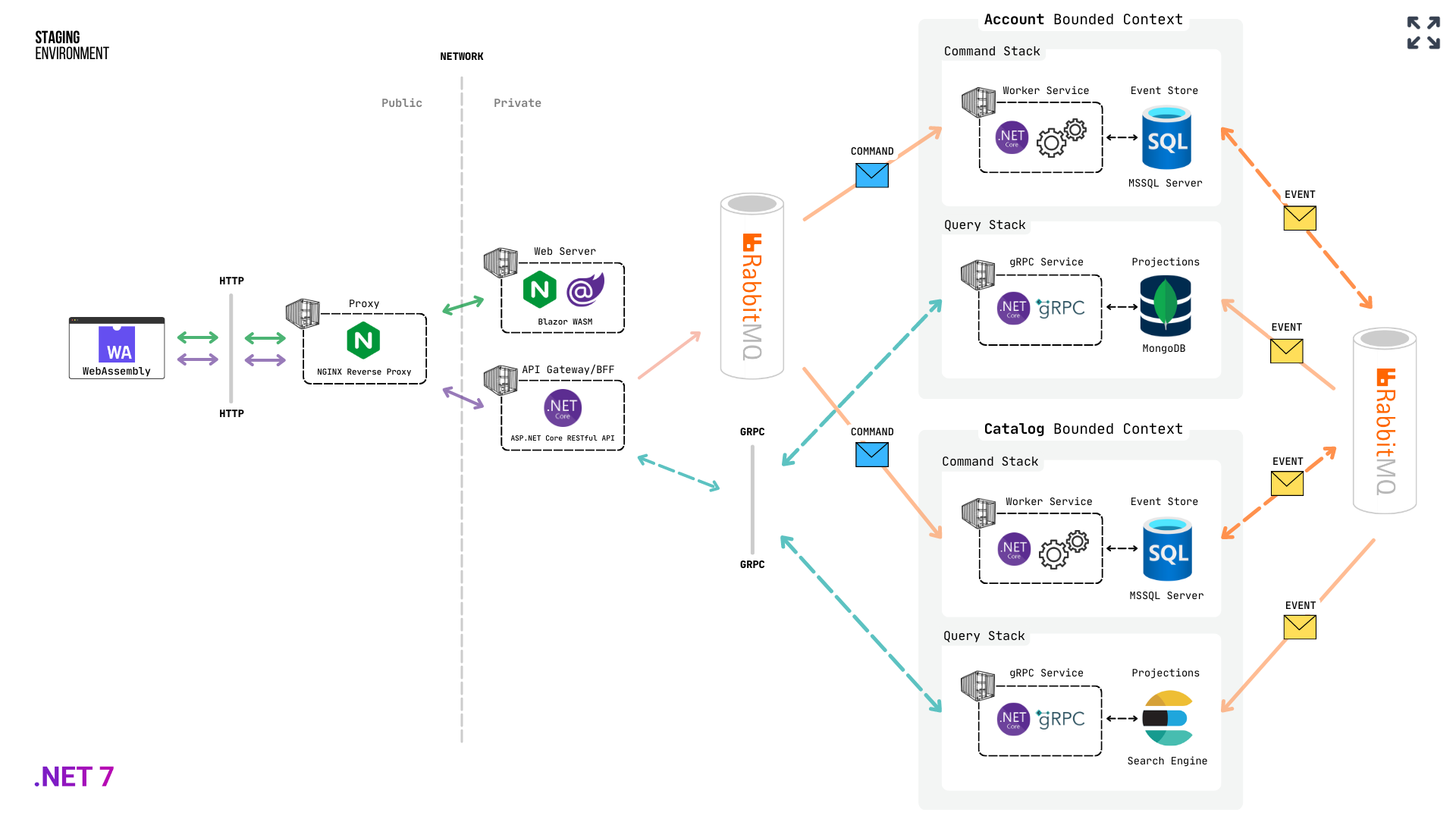
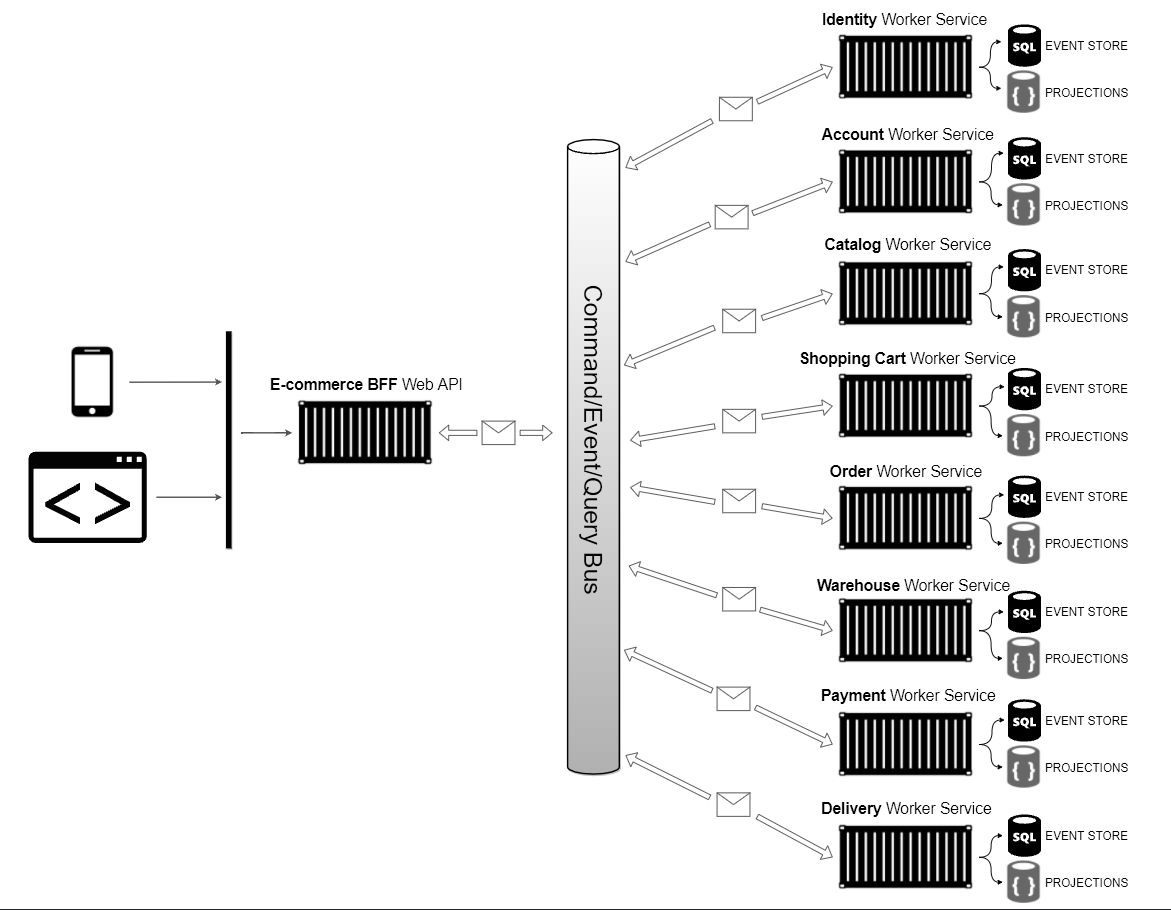
The reactive integration between Bounded Contexts configures an Event-driven Architecture (EDA) where Commands are acknowledged and sent to the Bus by the Web API (BFF/Gateway) while Events are broadcasted to the Query side and/or other Aggregates.
Independence, as the main characteristic of a Microservice, can only be found in a Bounded Context.
The Event Sourcing is a proprietary implementation that, in addition to being naturally auditable and data-driven, represents the most efficient persistence mechanism ever. An eventual state transition Aggregate design is essential at this point. The Event Store comprises EF Core (ORM) + MSSQL (Database).
State transitions are an important part of our problem space and should be modeled within our domain.
-- Greg Young
Projections are asynchronously denormalized and stored on a NoSQL Database(MongoDB); Nested documents should be avoided here; Each projection has its index and fits perfectly into a view or component, mitigating unnecessary data traffic and making the reading side as efficient as possible.
The splitting between Command and Query stacks occurs logically through the CQRS pattern and fiscally via a Microservices architecture. Each stack is an individual deployable unit with its database, and the data flows from Command to Query stack via Domain and/or Summary events.
As a domain-centric approach, Clean Architecture provides the appropriate isolation between the Core (Application + Domain) and "times many" Infrastructure concerns.
:star: Give a Star!
Support this research by giving it a star. Thanks!
:classical_building: The Solution Architecture
V2
V1
:mag_right: Research
<details> <summary> Agnostic Obsession </summary>Agnostic Obsession
Agnostic obsession is a design approach that focuses on creating software unrelated to any specific domain, application, or technology. Some strategies adopted in this project are related to particular principles, such as the domain-centric to support the business (Reactive DDD and Clean Architecture); Event Sourcing + object-relational mapping (ORM) for persistence mechanism; Containers for immutable environments; and Kubernetes (K8s) for cloud deployment.
The domain-centric approach is a design pattern that separates the core business logic of an application from other concerns, such as the user interface or infrastructure, making it easier to maintain and extend the application, as the core domain is isolated from other system components. Additionally, the ability to move the core domain to different applications while keeping the essence of the business can be helpful for organizations that need to support multiple applications or platforms.
A key aspect of agnostic obsession is event-sourcing and object-relational mapping (ORM) as a persistence mechanism. Event sourcing involves storing the history of events occurring within a system rather than the system's current state, **avoid
